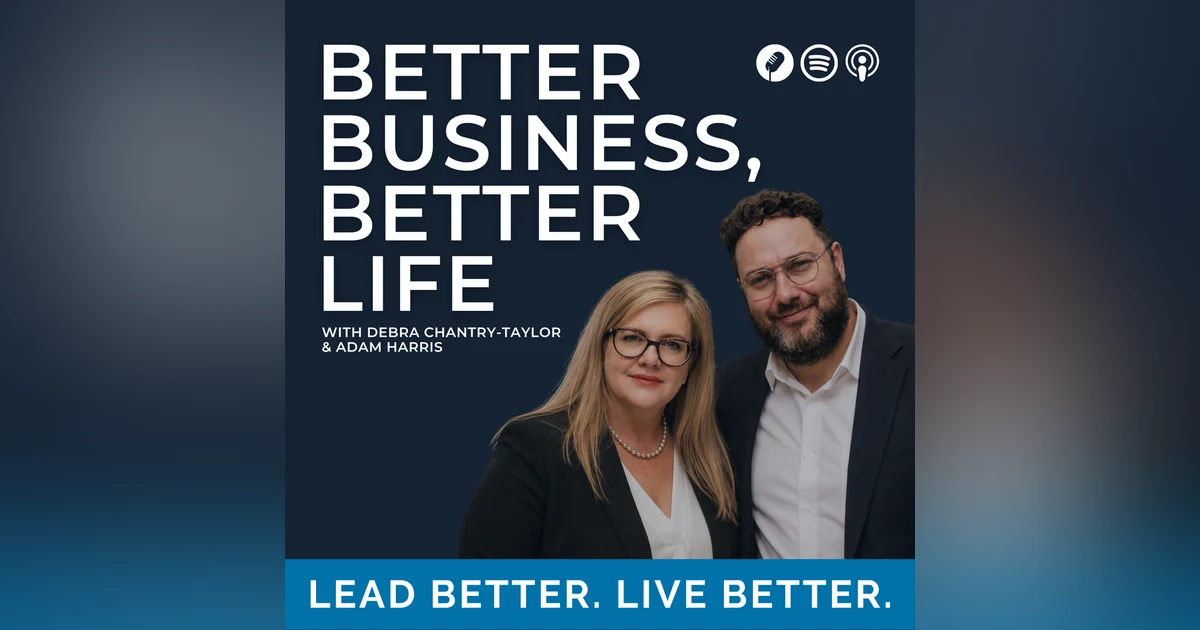
Kris Snyder: The Next Evolution of EOS Powered by AI
In this episode of Better Business, Better Life, Debra Chantry-Taylor is joined by Kris Snyder, Chief Advocate at Ninety.io, to explore how EOS® Powered by AI is helping leadership teams work smarter, run better meetings & build scalable businesses.

 Spotify
 YouTube
 Amazon Music
 Apple Podcasts
 RSS Feed
 iHeartRadio
 PocketCasts
 RadioPublic
 In this episode of Better Business, Better Life, Debra Chantry-Taylor is joined by Kris Snyder, Chief Advocate at Ninety.io, to explore how EOS® Powered by AI is helping leadership teams work smarter, run better meetings & build scalable businesses.
Kris shares his journey from building five software companies & surviving the dot-com crash to becoming an EOS® Implementer & one of the driving forces behind Ninety.io. Today, the platform supports more than 18,000 companies & over 300,000 users, while staying grounded in the core principles of EOS®.
A major focus of the conversation is how AI is transforming the way businesses use EOS®. Kris explains that AI is not replacing the EOS® process or the role of the EOS® Implementer. Instead, it removes administrative work, surfaces insights & helps leadership teams spend more time solving real business issues.
Debra & Kris discuss how AI-powered tools within Ninety.io can improve meeting preparation, identify patterns, provide visibility into team performance & help leaders ask better questions. They also explore how Ninety.io is balancing innovation with the simplicity that makes EOS® so effective.
Beyond technology, Kris shares why exit planning should begin long before a business owner is ready to sell. He explains how EOS® helps businesses become less dependent on the founder by building stronger leadership teams, clearer accountability & systems that allow the business to thrive independently.
Throughout the episode, Debra & Kris reinforce that while AI can improve productivity & efficiency, lasting business success still depends on clear leadership, disciplined execution & meaningful human relationships.
This episode is essential listening for entrepreneurs & leadership teams who want to understand how EOS® Powered by AI can improve meetings, strengthen accountability, simplify operations & build a business ready for the future.
CONNECT WITH DEBRA:
___________________________________________
►Debra Chantry-Taylor is a Certified EOS Implementer® | Entrepreneurial Leadership & Business Coach | Business Owner
►Connect with Debra: debra@businessaction.com.au
►See how she can help you: https://businessaction.co.nz/
►Claim Your Free E-Book: https://www.businessaction.co.nz/free-e-book/
___________________________________________
GUEST’S DETAILS:
► Kris Snyder – LinkedIn: https://www.linkedin.com/in/krissnyder/
► Website – Kris Snyder: https://krissnyder.com/
Ep 281 Chapters:
00:00 – Introduction
47:04 – Transition to EOS and Ninety.io
47:19 – Changes in Ninety.io and EOS Purity
47:33 – Impact of AI on EOS and Ninety.io
47:47 – Challenges and Opportunities in EOS Implementation
50:11 – Planning for Exit and Personal Growth
50:44 – Advocacy and Community Building
53:26 – Final Thoughts and Tips
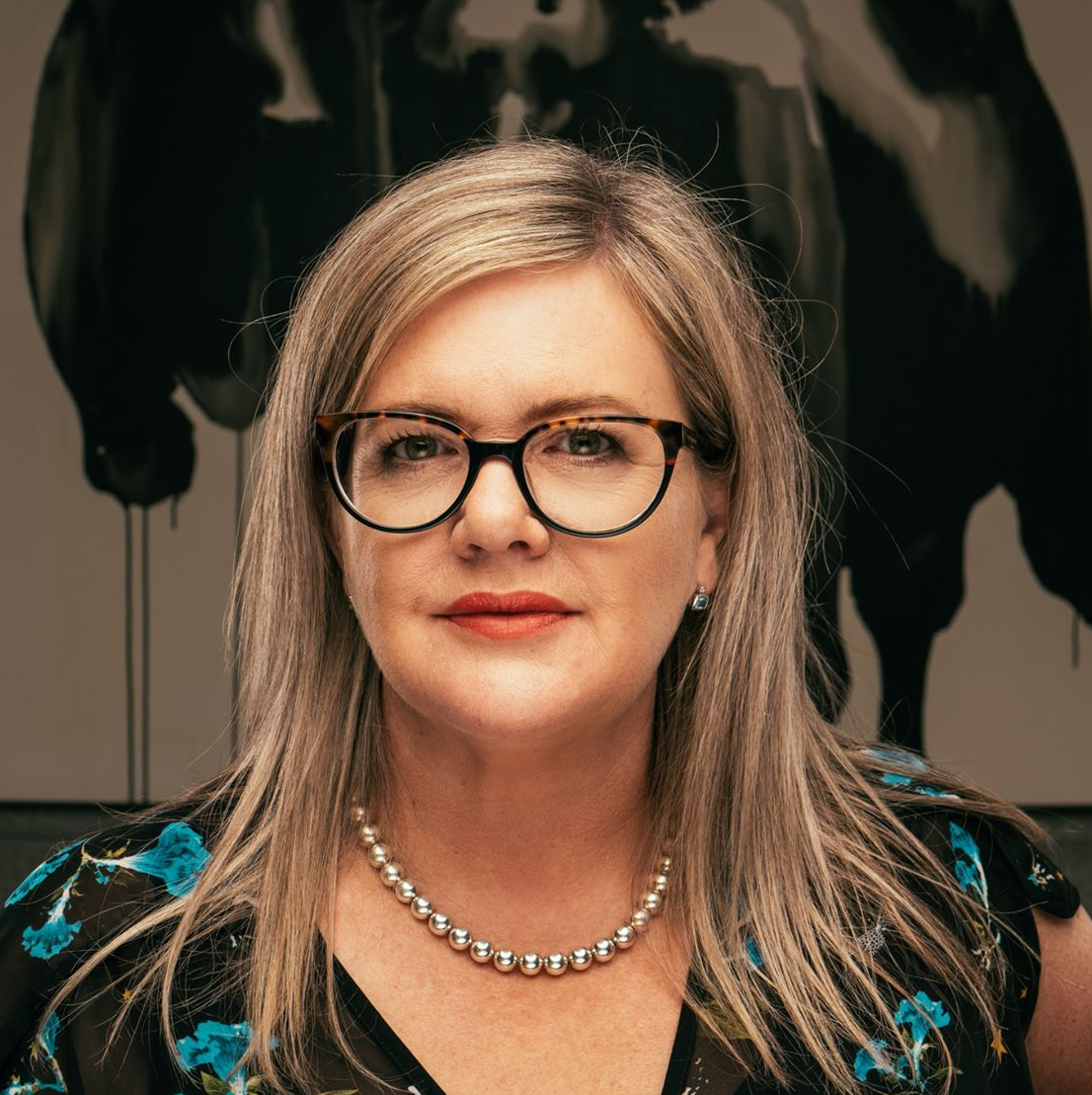
She is based in New Zealand but works with companies around the world.
Her passion is helping Entrepreneurs live their ideal lives & she works with entrepreneurial business owners & their leadership teams to implement EOS (The Entrepreneurial Operating System), helping them strengthen their businesses so that they can live the EOS Life:
- Doing what you love
- With people you love
- Making a huge difference in the world
- Bing compensated appropriately
- With time for other passions
She works with businesses that have 20-250 staff that are privately owned, are looking for growth & may feel that they have hit the ceiling.
Her speciality is uncovering issues & dealing with the elephants in the room in family businesses & professional services (Lawyers, Advertising Agencies, Wealth Managers, Architects, Accountants, Consultants, engineers, Logistics, IT, MSPs etc) - any business that has multiple shareholders & interests & therefore a potentially higher level of complexity.
Let’s work together to solve root problems, lead more effectively & gain Traction® in your business through a simple, proven operating system.
Find out more here - https://www.eosworldwide.com/debra-chantry-taylor
SUMMARY KEYWORDS
EOS tools, business clarity, software implementation, Maslow's hierarchy, self-actualization, family business, exit planning, AI integration, meeting efficiency, personal BTO, accountability chart, leadership team, business growth, community building, advocacy.
SPEAKERS
Kris Snyder, Debra Chantry-Taylor
Kris Snyder 00:00
Because I was in technology my entire time, I said there must be technology here. There's got to be software out there that'll help U.S. implementers do better. Went and found 90. I think it was four employees at the time. We were talking to an EOS implementer, and his first question to me was, "Is this the software that's going to replace me? And my response was, "Are you replaceable? What are you doing that you evolve the stages of business building, and at 90, we started using Maslow's hierarchy of need. Stage one: If you don't have food or water, what else do you think about? Stage two: Now I got to have safety. I have to shelter. Three: I get to community belonging. All the way to five: Self actualization. Businesses are kind of same way.
Debra Chantry-Taylor 00:42
Bridge Chantry. Chantry-Taylor and I'm passionate about helping entrepreneurs lead better lives through creating a better business. I'm a certified EOS implementer and an accredited family business advisor, and I use the EOS tools as an implementer to help people get clarity in their business because clarity creates confidence. I started this podcast many years ago to actually share experiences, share stories, have help people understand practically and pragmatically how these tools can help you create a better business, which of course will lead eventually to a better life. Today's guest is really interesting. He has built five different software businesses. He built a 150-person business in the dot-com boom, and then lost it when the bubble burst. He was originally an investor and an advisor to 90.io, which is one of the EOS licenced softwares, and now he is their chief advocate. Today, we're going to talk about how meetings kind of suck, how software can help you to really improve your business, and how the EOS tools can simplify to really help you get what you want out of your business. I'd like to introduce Chris Snyder, who is a certified EOS implementer and the chief advocate of 90.io. Welcome to the show, Chris.
Kris Snyder 02:02
Debra, I've been looking forward to this for a while.
Debra Chantry-Taylor 02:04
Yeah, I can't wait. I was just saying before we go on the podcast, I haven't actually heard your EOS story. So you are a certified EOS implementer like myself, and also the chief advocate for 90, which is a licenced EOS software. Love to hear your story of how you got to be where you are today.
Kris Snyder 02:21
Post college, I went to work for a family, 100-year-old family-owned company, and I held seven roles in seven years. And that's really where I learned the art and science of business. But that wasn't my family, and so you kind of come to realisation, right, Debra? That that if you really want to be an entrepreneur, you probably should go do something else. And so, as much as I enjoyed that time, it was time, and exited that exited me into the.com time. So I'm old enough to so did that run right. The the company raised money and at dinner on a napkin and had a great couple years. We built the company to 150 people, and then the music stopped.
Debra Chantry-Taylor 03:02
I remember the.com bubble boost.
Kris Snyder 03:05
And and Debra, the thing I you know I like to think people who didn't live it is we knew it. Like I knew it. Like the things were not real. The things that we were doing, the deals that were closing. It just you kind of looked around. You're like, where's the reality here? What's the reality? So so post that it was to go try it again. So I, you know, built five different businesses, not including the last couple probably, but the one I exited in 2018, which is how I came to EOS, was one of those moments where all of a sudden, good news! I had a had a decent exit. We eventually sold the the entire company private equity, but I didn't know what I was going to do. Like it's now what, right? I was too young and in time to retire, and wanted to still contribute and be of service. And started talking to my friends about you know, do I build something, buy something? I really like the the advocacy and the board seats and whatnot, but that that didn't seem like a career. That seemed like something to do in addition. So, good friend of mine that staffing recruiting companies bought one. He was self-implementing EOS at the time, and he said, "Hey, there's never heard of this thing. Hadn't heard of it in the moment. I heard of other frameworks like Lenchioni's Advantage, so it wasn't foreign, but it definitely hadn't heard of EOS and traction overall. And so, got introduced to it. He just bought a company in Maine and said, "Would you go implement? And Debra, that was back in the days where we had Basecamp, right, where you could become an U.S. implementer through Basecamp before going to boot camp. And so I did sign up for boot camp in October, but I started doing U.S. implementations in July of 2018. And I thought I'd just do it to you know see and pass some time, and then fell in love. Like it was like, wow, this is a job. This is amazing. And then my thesis changed. Right, it's like, well, I really want to, you know, be a U.S. implementer, coach, and advise, and then I can sit on advisory boards. I can be an investor in these companies, and I think that sounds like a good gig. Because before you become an investor, you get to know the leaders, you get to know the founders, and you can decide if you like the market and the team. And that's so much better than just putting your money in a fund and letting somebody else invest for you. That's my theory. So because I was in technology my entire time, I said there must be technology here, right? There's got to be software out there that I hope that U.S. implementers do better. There was only really two, as you know. I went and found 90. I think it was four employees at the time. They were south of $50,000 in monthly recurring revenue, and hit it off with Mark Adam, the founder. So I became one of the you know first investors and advisor to the business in 2019 while I was doing U.S. implementations. Didn't think I would actually, you know, ever kind of work in the business as much as just be an investor, advisor, right? Be their coach, that kind of thing. And really, in 2020, when the pandemic came, Mark asked if I would join the team, and I joined as a CFO, and I started helping out in revenue and the channel. And that's one of those moments, Debra. I was kind of like for those that can remember Gilligan's Island. I said I would do the I would do the CFO job for three months, and it took three years before I wasn't the CFO of the company. So it was definitely longer than I thought, but it was good. You know, got to use a lot of skills I picked up along the way. That's kind of how I found 90. Never stopped doing EOS implementations. At the same time, I think one year I did 110 while I was doing all the 90 stuff. That was crazy. Shouldn't do that. It's 110 as you know, is a lot regardless of having a second job in the mix.
Kris Snyder 06:36
So everything kind of went down to like 40 sessions the last couple years, and I'll be in that ball per 4050 probably this year as well. Coming through, I've been balancing my two worlds between kind of supporting 90 today is, and it's just super excited for what we build. We have 18,000 companies running in the software now. We've got 300,000 paying seats. We're probably I think around 40-3 million in annual recurring revenue, still growing 2020-5% year over year. A little north of 110 team members, so it's been now it's been a good it's been a good run.
Debra Chantry-Taylor 07:14
It certainly has, and and so you split your time what 5050 between being in 90 and doing your EOS implementation.
Kris Snyder 07:20
That's correct.
Debra Chantry-Taylor 07:21
Yeah, and so I'm interested because you know 90. So Mark Abbott, when he when he had the idea to build the software, obviously when you came on board, it was quite a small business. It's now a massive business. How do you think things have changed in that time?
Kris Snyder 07:35
Well, some things have changed a lot, and some things have not. I think, as as you know, I know from an EOS perspective, EOS purity, and I think Gino is officially on record saying he he built it and wrote it to sustain 100 years. So I think there's been a lot of not change, especially in the the community that's you know coached by implementers like you and myself. But if you go into the self implementers, let's call that 90% of the market, I think that's the U.S. Worldwide's reported percentage number. We have about 50% of our 18,000 companies are self implementers. We love that community. I think we should always work and support and feed that community because that is how they grow. And I think then they eventually grow into the place and the phase and the stage where they need help from folks like us. But those folks change a lot, so if you look at 90 as you know software platform, and we get into this conversation with ES implementers pretty often, they'll they'll point out the things that are in our software. You know, some are very EOS pure, like the fun, you know, the functional things, the tools that you would expect. And then let's just pick on scorecard for a minute, Debra. We have a lot of feature and functionality in the scorecard because of the 300,000 users. We get feedback all the time, and what they want to see it do. Whereas if we look at a pure EOS scorecard, 13 weeks in the quarter, right, and how it's set up, that is not what they expect to see in our software. So when you talk about things that changed over time. I think there's, especially in the self implementers, we've seen a lot of requests for additional features and functions that are beyond EOS Pure, and so I think there's those those pieces. So trying to still honour it. We've got a whole initiative right now around EOS Purity, and and my my bet is we come out as next quarterly because we have a quarterly next week with with a rock, and that is to take you know and create an EOS pure template. I talked to US Worldwide about working with them on it because I think who knows better about charity. I still have my questions Debra times around it when debugging it in an EOS pure fashion. So we're hopefully we'll be able to work with them on it and creating a EOS pure template stuff does that really want that can have that, but yet we can still serve the market that is asking us as a software company to build additional features and functions in it. So that's some of the things that changed along the way. Just with all that feedback, you know, if you look at some of the tools, they've just evolved quite a bit from where we started in 2018.
Debra Chantry-Taylor 10:00
When did you become a new US implemented, Chris? It
Kris Snyder 10:02
was in 20 October. I boot camped in Denver. I was the the first boot camp in Debra in 2018 October.
Debra Chantry-Taylor 10:07
2018 Okay, so I started in 2020 We did my boot camp in 2019 actually. Yeah, and and I've been on on 90 with most of my clients for all of that time, and I've certainly seen the sort of changes and things throughout that time. Biggest thing for me at the moment is this whole AI thing, and I don't know if you saw, but I recently I had somebody try to tell me on LinkedIn that you know EOS was going to be dead because AI was taking over the world, and there would be no need for EOS, and it was a dinosaur, and it didn't you know it didn't keep up with where AI was going, and it really caused me to reflect a lot on what does that really mean, and I came to the conclusion that actually, EOS will always be here because business is about humans, and we're always going to have humans in the business, even if we do have AI to help us. But I know that it is certainly adding a huge amount of value to these kind of software tools because it can analyse data and look at things so much more quickly than a human ever cat, so yeah. How? Where do you see it in in the 90 tools and in your EOS practice as well? I guess.
Kris Snyder 11:07
So it's existential, right? And I and I think we were at EOS conference last year, and there's a couple things that happen. Some EOS implements will come up in the conference. I don't know how maybe EOS implements, maybe 100 but you know what was the conference 2500 people or something, so it's a lot of clients, prospects. But we're talking to you know a simple matter, and his first question to me was, "Is this the software that's going to replace me? And my response was, "Are you replaceable? Right, like that's the moment. So what are you doing that you evolved? It's yes, it's existential, and that person who's arguing with them on LinkedIn-that's only true if we we don't evolve as EOS implementers, and we find the the value to be added because some large percentage of our time is saying and administration. I think Debra, that that goes somewhere like for the EOS session that you do, there's at least another half a day of you know pre and post type of work that you do, and you know my theory has been that I can cut that down by 25% using AI inside 90 and other tools. So if I do that and I do 100 session days, that would be 50 days of you know kind of admin pre and post. I could have done 25 We now have another 25 days to go help clients. Do you mean that's exciting, right? Like there's there's depth there, but now let's go back to 90 as you know as an example. So we're not native because we started the company way before AI was a thing for this market, but we've been ingesting AI. So it's kind of a hybrid model, and we started with as you probably know the rocks, right? How to help people make smart rocks, especially if 90% of the market doesn't have access to an EOS implementer. Rocks are one of the key components, right? To not 816, but it's a fundamental thing that you need to do every quarter, right? Establish your goals and execute, and people struggle with that. So we did that first, and then we went to the accountability chart, also another challenging tool, especially if you don't have an EOS implement in the moment, and then went into Scorecard Optimizer. So we had those three tools first, and now what we've taken to GA is what we call Ask Maz. So I don't know about you, Debra, but I'm a huge fan of Maslow's hierarchy of need, and we started, you know, years and years and years ago at 90, talking about when AI arrives, what do we want it to do? Well, we wanted to help you know every individual that's associated in an EOS company become a better, best version of self. Well, how do you do that, right? Well, you can't just coach. You got to coach all the way to the individual level. You got to have the teams. You got to have the departments. You got to have the leadership team. You have the whole company. But that's our vision for Maz is to be able to help everyone become a better, best version of self, which is why it's called Ask Maz. So, what's cool about Ask Maz is it's not an individual tool, so it sees across the entire platform. So, as an example, if I've been using Maz for quarterly's, when I did a quarter this week, I just went in there, you know, the day before and said, "Mass, tell me everything about the team and the company related to Rock's performance scorecards, and then it's just normal prompts, right? If you're used to AI, and it just tells you everything that's been going on that it can see. Debra can ask it, like, how that Rock's off track. How many times did that team actually IDS on it? And in the moment, it's not about finding something to call the team out on, right? It's call them up. Like, how do I be a better coach in the moment and facilitate them needing better? Talk to the integrator ahead of time, saying, "Hey, this is what I'm seeing.
Kris Snyder 14:31
What do you think? Right? And normally, when you have that conversation ahead of time, the integrator, you throw it. They'll they'll decide to throw a few more issues on the list, right? For us to actually think about why did that rock, you know, never got milestones, never became smart along the way. What were we thinking? How are we handling it? Didn't we not see it every week in the level 10?
Debra Chantry-Taylor 14:52
And why didn't we? Why didn't we IDS it
Kris Snyder 14:55
here? Yeah, and and again, it's it just unearths a different level of deep. And information such that we, as individuals and as team members and as EOSIs, can can be better, right? And then we can do more by by the having access to this information. It's not meant to do the work, right? It's not even meant to like teach. It will it will teach at some point because that's what AI is going to do. It's really meant to be the explainer moment of how does that thing work, and when I say it's going to teach, you know, our our agreement with the U.S. worldwide is to not have the AI teach as much as we can because we want it to actually still be the learning that happens with the leaders, the learning that happens via the EOSI. But you know, you look at even the EOS worldwide chatbot that they put out. It kind of teaches.
Debra Chantry-Taylor 15:46
I was going to say, I think of the three roles that we play. You know, the coach, the teacher, and the facilitator. I think the teacher is probably the least one in my in my practice anyway, because anybody can go and learn from watching videos, from reading books, from that sort of thing. So the teaching, sure, we can add a little bit of extra stuff in terms of pragmatic, practical experience from other companies, but I think it's the facilitation, the coaching is where we really add the value. And it's going to be difficult for AI to really ever do that because it can't not yet at this point. It can't sit in a room. It can't observe the energy. It can't see what is going on. It can pick up on trends and things, and it can challenge you, but it's not going to be the person who calls it out in the room.
Kris Snyder 16:26
I went to a client's picnic last weekend, and it was fun because I got to meet beyond the leadership team. But how many how many opportunities had to do that? But I I enjoyed right to hear kind of like how they feel about EOS and things that nature, but at one point I was talking to one of the leaders, and they had just met two other EOS companies. One by chances that I've coached in the past, and one another EOS implementer had coached. And they asked if they have tears in their meetings, and the other client in mind said, "Of course. And the other one was like, "What? He's still crying in the session room, and and and I'm not thinking about anything better than the fact that that's what facilitation is. We go deep. We enter the danger. We we help them find their way to the the radical candour when it's needed, right? We help them do truthful, specific, and positive and TSP, and that's facilitation. You're reading the room. You're opening the the door for them to walk through, even when they don't. Yeah, they don't even you've seen it, right? They they cross their arms, they pull back, and the guy goes check in and see if they can do it, if they can actually step forward, right? Yeah, I'm not going to do that anytime soon. And just that that's such a learned skill of reading the room the right way, building the trust that they believe that they do that, and with your presence, they feel they're safe, right? And I am like that. Brene Brown's got a good quote where it's not such thing as a safe space. There's a brave space, and so I'll say that to my clients: like, look, open, honest, vulnerable, and even brave today. I want you to be brave. Like there's going to be moments when you're going to think twice about it, and that's part of that vulnerability and being open and honest. But you need to be brave in the danger.
Debra Chantry-Taylor 18:12
Yeah, absolutely. Yeah, and I mean, you've been talking about how the AI can help us as implementers in terms of understanding what's going on, but it's also a great tool for the leaders in the organisation too, because they can ask the same questions, right? Tell me what's going on. It can help them prep for their level 10 meetings. Can help them get ready for just the general kind of day to day stuff and get the most out of it. 100% and Debra, because it's you know we're
Kris Snyder 18:35
Colby fans. Hopefully, you know, simple matters, but also you can put in Myers Briggs and you can put in disk, and it's in our in our directory profiles. And then, so what what the AI extrapolates out of that? If you and I are about to have a one on one, maybe you're the visionary on the integrator. We're going to have same page meeting. It does meeting prep now, and it can help you prep. And it will remind me of your Colby and how you give and receive information that is different than mine, because most likely, if you're the visionary, our Colbys aren't the same. If I'm the integrator, right? And it's always just a good reminder. So now you think about meeting prep, both at the L10 level, the individual level. The more it knows about you, knows your seat, right? Because it's in the accountability chart. It knows your scorecard, so you could even have it help you. I don't know about you, but I'm a big. You got to plan your. You got to plan your work that you got to work your plan. I think that's from David Allen and get things done. So every you know Sunday night I do that. It's so much better now with AI inside the software because it knows all my stuff, right? And you can even whether you're Microsoft or your Google Shop, Gemini, Copilot, you can even go into your calendar and ask it about. You know, David Allen has this whole like, you know, Mindsuite calendar check, right? Where you go back two weeks, the week you're in, one week forward. It used to take me a while to do that. Now, just you just ask for me Gemini, and then I take that information. Put it in 90, and I'm assembling my plan now. And a fraction of the time it used to take me on a weekly basis.
Debra Chantry-Taylor 20:05
That's beautiful,
Kris Snyder 20:05
and that's at the individual level. That has nothing to do with being in the EOSI. Like all leaders should be clearing their work and working a plan.
Debra Chantry-Taylor 20:12
Absolutely, that's great. I know one of the biggest tools in EOS that self implementers particularly love is the kind of level 10 meetings, and I know that you have written a book called "Meetings Kind of Suck. And I think for a lot of people listening in, you know, because we get very passionate about our meetings, we love our level 10s, we love our quarterly, we love our quarterly conversations and things. But for a lot of people, particularly if they've worked in a corporate type environment, they haven't had good experiences with meetings, have they?
Kris Snyder 20:41
Yeah, because no one taught them how to, right? They they showed up and you know all of a sudden they they were in it. They didn't even understand it. I go back to the first meetings. You know, coming out of college in a corporate environment, you just start showing up. They didn't have a clear objective. The agendas were like you know happenstance, and then when they got done, they didn't know if it was a good meeting or not. But we know, as implementers, you gotta every great meeting has to have a great objective, a clear objective. It has to have a solid agenda, whether it's a level 10 meeting or not. And I don't know about you, but I read every meeting. If you and I are about to have you know a same page meeting, I'd still read at the end because it's the feedback loop. It's this thing that keeps us aligned around did we do the things we said we do, because that it's not a 10, and you know 10's not perfection; it's high performing. Then we got to talk about it, and I think that's the that's the moment that really connects these things inside the meeting. I never wanted to write a book, Debra, especially not a meetings book. No, it
Debra Chantry-Taylor 21:36
doesn't sound like the most exciting book to write. No,
Kris Snyder 21:38
no.
Debra Chantry-Taylor 21:39
But tell me more. Tell me more.
Kris Snyder 21:41
Well, 90, we were studying. You know, when we lost companies, specifically self implementers, what happened? And the ones that stayed and found great value, the thing they started with, that the thing they did the best at was running meetings. Like they actually figured out how to run a level 10, and then they started thinking about quarterly conversations, and they started, you know, getting to quarters and annuals, right? They would progressively into the meeting pulse from an EOS perspective, and we're like, "Well, why are the ones that? What do they not figure out? And so we we talked to them, and they gave us a bunch of feedback. They're like, "Well, we don't have to do this. Like, how do I facilitate the meeting? Like, what are the tips and tricks that I'm supposed to think about. How am I supposed to do block? Yeah, they just so we started getting honest feedback, and we're like, oh shoot, they're right. And then so I went and pulled a bunch of you know a lot of meeting books out there. By the way, they're pulling, and I am a fan of Patrick Patrick Blancioni's death by meeting.
Debra Chantry-Taylor 22:37
Oh yes,
Kris Snyder 22:38
but it didn't speak to ELS right as much as I like his framework, it wasn't for EOS companies, and that's obviously who I'm trying to affect and serve, even from a 90 perspective. So the good news is, you know, last year EOS Worldwide put out there for the US implementers like ourselves the EOS Impact Series library, so we as implementers could come use Igniting Souls, who is their their editor? By the way, they're awesome. So plug for igniting souls. If you guys have a chance, they they do a great job. Yep. So it gave us a chance to actually use the EOS trademark terms and have their editor make sure that the the content was being done the right way. The IP is protected from EOS in that in that moment. But yet, have your own. So meetings kind of suck. Often I get asked, like, where'd the title come from? My first thing is Lunchioni from Five Dysfunctions of a Team. He's got a podcast out there that I listened to at some point where he said that he wrote originally it was the Five Healthy Functions of a Team, and like nobody was buying it. He changed it to the dysfunction, and there you go. So I said to myself after I heard that, if I ever do write a business book, I'm going to follow that advice. And so I was on vacation last August with my family in Dublin, Ireland. We were at a pub, and good strummer, all the music's happening, and this guy walks in, black T-shirt and on the back, and it said, "Paris kind of sucks, and I was like, "That's funny. Nothing hits Paris, but as a U.S. citizen, at least it just kind of sucks, right? Even at times, and so I turned to my wife and I'm like, "Oh, I think that's the title of the book. Meetings kind of suck because not all of them, right? But just in kind of general as we think about them. If you ask people if they're excited about their Mondays, where they've got a lot of eggs, most of them dread it, and they dread it not because the meeting it's the meeting it's not it's not dreading the objective. It's dreading actually what occurs in the in the moment. So, we wrote I wrote this as kind of a field guide. You can pick up any coin. The chapters are just you know, different, and you know, there's been some really good, interesting things that happened since I met it, since I wrote it. I've had a prospect. For those who don't know us very well, we have this 90 minute meeting. If we you know meet somebody, we talk to them. They're interested. Then we you know say, hey, come give us. 90 minutes. We're going to go through the six key components. You'll learn a lot about your organisation, leadership team, and then we'll show you some of the tools. And if it's right for you, we'll move forward. And so there's a chapter in the book. It's called the Visionary Curse, and what it's about is the visionary, the CEO, dominates the room. They walk in. They think what they're supposed to do is command and control of the room to get to the end of the meeting to call it done and walk out of there. And you and I know happens is we don't do that as the assemblers. We create space. If you're in the room, you're in there for a reason. And even more IDSing, there's space for you to participate. That doesn't mean you have to or will, right? But we create the space because the power of the room is where it's at. And so, anyways, this CEO comes in and and he goes, "I read your book. I thought, "Oh, he's like the section, the section on visionary curse. I was like, "This could go south quickly. He goes, "No, you're right. And and because in the book, I say, "You're the problem, right? Just come out and stay because you're the problem, right? As a visionary, you can't be the problem in the meeting. He's like, no, you're right. He's like, I thought about it. He's like, I am the problem. I'm like, it's great if you're not the one facilitating as the visionary, right?
Kris Snyder 26:12
Hopefully, you have an integrator, you have somebody else, right, and and participate in the meeting, but don't write it, right? Like, you got to follow the format to get to the objective and in the moment. So that was an interesting one that already start to see and hear some people kind of relate to to some of the content there. But that's a reflection, right? We all, unless you haven't implemented, you probably haven't heard that before. That you know you got to create space for the rest of the team to participate.
Debra Chantry-Taylor 26:36
I actually see it happen with integrators sometimes as well. I think sometimes integrators feel like they have to because they're ultimately accountable for the leadership team and the the profit and loss of the business plan. They feel like they have to drive that whole meeting. And when we observe level 10 meetings, which we do regularly, you know, I sometimes have to remind them that it's it's it's a group effort and that we want to be able to take full accountability. And the way they take full accountability is if they have some input and they have some ownership of what's going on? So don't don't drive it; just facilitate
Kris Snyder 27:04
it. Again, chapter in there around the the math of the meeting, and it's it's basically calculating the cost of the meeting. And my point of that is to say that we pay everyone for the perspective in the room, and if they're if they're not equating value, we should ask why they're there, right? Because if there's only be two people dominate, then why we have the rest of the team here, guys? Like, like they're paid to be here. They are, and it costs us money. And if you're not, if that integrator you're talking about is not going to let them participate, we should reconsider.
Debra Chantry-Taylor 27:30
Yeah, that's actually a really good point. Yeah, I have a different. I have a different. I have a different maths that I kind of. I got. I talk about the maths in terms of sometimes I sit through level 10 meetings, and you might have six people in a room, and I always say, let's just say, for argument's sake, they're worth 500 bucks an hour to the company. Probably more than that, but let's just go with 500 That's a $3,000 an hour meeting. That is a four and a half $1,000.90 minute meeting you're having every week. And so, if we're sitting there talking about operational things that are you know costing the business this much, what are we doing? Why are we doing that? That should be pushed down. And you know, it's it's especially in the early days. It's hard for some of those people to do that. Is to actually allow it to go get down to the level where it should be dealt with.
Kris Snyder 28:09
Yeah, and and I would eventually. So, so you should read that, Chantry. It's exactly that. It's just walking through math in the meeting, get them to calculate it, and then taking it further and go. It's not just covering the cost of the meeting. Like if you're talking about sales expectation, like we want a three to 4x return minimum on a sales investment, so the value here, you know, three 4x this. So how are we creating that level of value? It's it's it's not if we're not actually addressing the real issues that move the business forward, right, and get us to our flywheel.
Debra Chantry-Taylor 28:39
Yeah, that's. I'm sorry, I haven't read the book. Actually, it's really funny because when I spoke to you just before the podcast, I I don't know why I haven't seen it in the series, but I'm definitely going to get hold of a copy of
Kris Snyder 28:48
it now. Well,
Kris Snyder 28:49
I think we've had like 20 some books in that series now, so it's probably it's a little hard to keep up with everybody.
Debra Chantry-Taylor 28:53
Got a few behind me, but
Kris Snyder 28:55
yeah,
Debra Chantry-Taylor 28:55
yeah, yeah, it's great. I mean, it is great. I do love that about EOS that whole the generosity of sharing information, and and you know, people always say to me, you know, don't you get pissed off with self implementers? It's like, no, no, I'd much rather they did something. I I want to give everybody in the whole world a traction book. I don't care. Like, if you don't, if you don't want to work with me, I don't mind at all. I just want you to get this into your business and do something with
Kris Snyder 29:17
it. Yeah, and however you think about the the stages of business building, and at 90, we started using Maslow's hierarchy of need as well for thinking this through. So, in Maslow's hierarchy of need, that's that's stage one. If you don't have food or water, what else do you think about? Nothing, nothing, right? Stage two. Now I got to have safety. I have to shelter, right? I have to start to think. Three, I get to community belonging, all the way to five self-actualization. Businesses are kind of the same way. Like when you start a business, what can you also think about? Nothing. I got to make payroll. I got to cover the expense. Like I'm so focused, I don't think about a three-year picture. I can't do that stage one. That's the start stage, and then you get into build, and then build. You start to think about I'm having. Everyone do everything because we haven't specialised yet, right? And one and two, those are mostly self-implementers because they can't get into the rest of it. And you want them to go think about their 10-year target, Wheeler. They're not ready. They can't get there yet, but they can run a great meeting, right? Like they can retraction. They can start thinking about it, and then they get to stage three, and they're in this growth phase. Now they're now they're starting to have a chance to work on the business a little bit versus in it so consumingly, and now they're actually meeting peers at that third stage. They're they're considering you know implementers, and so we start to see this. And we've been you know pulling our customers. We have 1000s of these assessments done now, and you can start to see U.S. implementers get brought into stage three, and then by the time you go from start, build, grow, force scale, and this is where the bulk actually hits, right? Because now they want, now they can not only afford it, but they can invest in their business, so they can actually take the time out outside of the business. They can hire you. They can bring in tools like 90, and now they're ready for scale, and they've hit ceilings along the way because they've been in pain. So when you bring that to them and saying, "Aren't you ready to be out of pain? Like pain's forever? But yes, I'd be out a little bit less right now. Always try to scale the business, and then that that stage is really exit optionality or investability, and you know that's a very important part because often they haven't. You know, until they get to that fourth phase, they really have to start thinking about like what is that? How do we build a company of value? And we talk about value in the focus day, the first day of implementation, right? Like we're here to help them create value. Often, my experience is then they hear revenue, and if they don't understand. It's like we're all. It's it's really it's value, right? The value of that business is sustainability beyond the founder, beyond the leaders, right? So that somebody else could come through and say, whether it's an ESOP, the employees taking over, somebody invests in the business, that's maybe the next generation takes over the business because it's bankable, so they can afford to, right? There's all those things that come through, but those five stages are really important to us. But we can see them in the self-implementers, and as they progress, and you could see somebody go the whole distance because they actually just keep investing in someone internally to do it. I'd say God bless God's feet if that's your path and that works for you. Then go do it, grow and build a great business and build a better life, right? I think that's your tagline, something like that.
Debra Chantry-Taylor 32:25
Yeah, but it is a better life. That's what it's all about. I mean, the end of the day, I mean, I'm very passionate about business. I know you are too, but we do it because we actually want a a better life overall for us and for all the people that we're involved with.
Kris Snyder 32:37
I don't think we have that. It's probably because of core values in the U.S. worldwide, but you you know that most of the U.S. implementers are thinking about service and contribution, right? They most likely had a pretty early successful career. It's the one of my story, right? Like you've done a good amount of work, right? You've learned a lot along the way. You're like, now what? What about this work? How am I have service to others, and I contribute back. And you help those other business leaders. Struggle is real. You just don't have to struggle alone. You don't have to repeat the same mistakes if you don't want to, because you've got people that can help guide you through that.
Debra Chantry-Taylor 33:12
And I know you're really passionate about helping people plan their exit, because I think you're right. Is people don't necessarily think about it, and it isn't just about the money you're going to bank at the end of it. There's a lot more to it, isn't it? I mean, because there's there's the personal side of it. There's the letting go if you do decide that you actually want to exit the business. I'm keen to hear your your views on what planning your exit looks like.
Kris Snyder 33:34
Have you ever read the book? It's lonely at the top.
Debra Chantry-Taylor 33:37
I haven't actually. No.
Kris Snyder 33:38
Yeah. So this is a personal side. Three weeks ago, I was getting ready to to go tee off golf with a friend, and he got a phone call. Not not a close friend of mine, but a close friend of his. I I know him well enough that we're investors in a company together. But he took his life. This gentleman had had an exit from a business, 100 million dollars, Debra, right? And you know he had built an incredible business software company, Exida, and don't know why. No one knows why. Ex on the outside, it looked like he had it all figured out: wife, kids, more money, right? And there's stories out there all over the place like that because people, entrepreneurs, put all themselves into the business, their identity, their success, and then the exit happens, and they're not prepared for it personally because they've been chasing that moment so hard to build something, and then you got plenty of cash. But now, what are you going to do, right? And so, what I, you know, my story can in 2018 when I accidented was got a good coach, but had to go figure out who I was built that business for 12 years, right? And I had to go figure out like who is Chris Snyder now outside of that company, and what am I going to go do, and how are my kids going to think about it because they're used to going in that building, going to the going to the holiday parties, and like I'm not I'm not in that business anymore. And it sounds weird for those that haven't actually experienced it, but it's real. And so you got to think about this. Is my passion about excite planning? There's a personal side to getting your personal side ready for it, right? You as an individual, your family ready as as whatever that links to. Getting your financial situation, knowing what your wealth gap is. Had a friend recently who you know thought that as soon as his businesses in the manufacturing space got to six times EBITDA, he was ready to exit. Got an offer for the six, sat down with his financial advisor and realised that what two houses, a plane, boats, he couldn't exit at that level. He had the wealth gap, right? And that was eye opening. But he shouldn't. He shouldn't be in that moment. He should be thinking about that ahead of time. Like, what's your number? And it's easy for people to say, but it's dynamic because our lives change, our passions change, our hobbies change along the way. So it's not, you know, just pick your number one time. It's something that you got to revisit at least, you know, every year. So there's the financial side, the personal side, and then here's where you and I come in. There's the business side, and if you decide that you know your business is worth picking up $3 million today, but it needs to be worth $30 million right in the next 510 years in order for you to to be able to exit. We got a $27 million gap, and that's not a revenue gap alone. That's a gap, right? It's like how do we get you know the best market scenario out of this? And so, the Exit Planning Institute EPI has got almost 10,000 certified exit planners out there trying to make a difference. They need more loss in in that community because there's a lot of folks who want to talk about you know the personal, the financial, but the business side really is where kind of operating systems coaching comes in to help them close that that gap. Again, struggle is real. You don't have to struggle alone. There's lots of great advisors, tax advisors out there, you know, M and A folks, attorneys. But how do we, you know, if you don't know them, then how can you help your clients with them?
Kris Snyder 36:56
And I think we've got I don't know. There's probably at least 100 USIs that are also certified exit planners, including myself, because you know, stop that. I want to go do different work. I want to be able to connect to that community when clients need it and bring them in, so we can we can close those gaps, and they don't have to have those moments that unfortunately sometimes end up in tragedies.
Debra Chantry-Taylor 37:16
I'm a I'm an accredited family business advisor on the other side, so my my passion is about really helping family businesses and and how they navigate the the additional levels of complexity that comes with family businesses. And same thing, it's not. I mean, I love EOS. EOS is absolutely everything that I do, but I just wanted to really understand and be connected with that family business side of things because it's tough. And I think you know that they have all the same things that every other business has, and then they have this extra level of family complexity.
Kris Snyder 37:44
Yeah, and I don't think people know. And I'm coaching a third generation family business right now, where the the the two sisters are in the business right now. The one sister is head of sales. The other sister is the integrator, and then the sister who that has sales, her husband's a visionary, and this is third generation. All super good people, Debra, but friction galore.
Debra Chantry-Taylor 38:04
Yes,
Kris Snyder 38:06
and that's that's one of the great things about EOS because we get to have same page. They get to have same page wings. We give them structure, but the owner's box is is hard, right? Like where are the decision rights for the owners, and they think they're having owner box meetings when they're not, you know, when they're just having other meetings, and giving them structure to do that, I'm sure you've seen it. It's it's it's it's. I think it's really hard for families to to make that transition.
Debra Chantry-Taylor 38:27
Yeah, I've just written a book about. It's called "You're the Future, Not the Founder, and it is about the second generation coming in and taking over from the first generation, which is where most of my work tends to happen. I've got a few that are third generation, but it's really more that's a second generation, and it's it's really hard because you have all these familial relationships that still exist, and all these dynamics that kind of go on in that family. And I love EOS because it does, like you said, it brings structure, it brings clarity, and obviously clarity creates confidence, and it takes a lot of the emotion out of it and gives you the the frameworks and structures to deal with it from a non-emotional point of view, which is exactly what they need.
Kris Snyder 39:05
And when West City goes south, and I've got probably three examples of the mine where it was like a father and a brother, and then you know where those sons is take you know taking over, and it's all good for a while when it's good, and then it gets hard because something happens like a pandemic, and then all of a sudden they're back in the business, right? Because all hands are on deck, and then it gets really weird because they didn't really want to be back there, but something existential happened, and now they're they're trying to help like get the thing back because really their their wealth is connected there, right? They can't have it go south, even if that son or that second generation trying to take over or run it, I should say. It's you know, it creates a digital complexity in the family.
Debra Chantry-Taylor 39:45
Yeah, it is. I do. I do love it, but I understand it can be very challenging at times. Lots of different domains going on. Anyway, gosh, and I love being an EOS implementers. I can tell you do too. And I love the '90s software as well. I use it with my own businesses, and then also. My clients as well. I think that anything that can help you to just make business easier, because as business becomes easier, your life definitely becomes better, and that's the most important thing. Chris, I need to ask three top tips or tools. You know, I love I love people listening into these and getting very motivated, inspired, but I want them to also move away and kind of go, okay, this is something I can actually do right here, right now.
Kris Snyder 40:23
Personal planning. So most people don't know Debra is a personal BTO. Would you? Is that fair? They don't. They don't.
Debra Chantry-Taylor 40:31
No, they don't. I definitely don't. Yeah.
Kris Snyder 40:33
And if you read EOS Life, which I highly recommend, anyone has chance. It also talks. I believe it talks about it in there, but I think maybe where else has talked about the personal BTO? That's the only one I can think of.
Debra Chantry-Taylor 40:48
I don't know. Yeah, no, I've had Scott Russnick kind of on the show, and he's talked a little bit about it. And I've certainly, yeah, we've done a little bit of work on it. It's it's a great tool.
Kris Snyder 40:56
Yeah, looks good. I've talked to him this week. He he and I were going to do a personal implementer day, and I think September we're gonna do that. But anyways, he's all about architecting your life, which I think is why that personal BTO pride came up because that's really what it is. Like it's you still have core values as an individual. We have them as a family, which are different than mine and my wives, right? But deciding those frameworks that you can pull forward. I believe the 10-year target is not a 10-year target; it's the wish list, which I found like a really interesting exercise the first time I did it. When people are asked, like, "What did you learn that was interesting? That was this was years ago. Debra, when I first you know we learned about the PDTO, the wish list. But I realised I wanted to be a grandfather, and this was my my daughter's now 18 and 21 But I never thought about that before. Now I can't control any of that, but it's a wish, right? But it's just interesting to kind of go through that. It's not a bucket list, right? It's a wish list, which I think is really interesting. So I'll I'll just put that out there. I think the personal planning side, the PBTO, is such a if you know EOS, it's such a good thing to do along the way. And the second one really is, you know, famous plug for 90 because we read all these tools and concepts and PDFs, and but to bring it to life beyond you is the key. We like to see in EOS like everyone working as one and rolling out EOS. How do you do that? How do you go get everyone on the same page, right? If you're 100 people, 50 people, 25 people, it's just too much friction. But now with the software, we talked about AI earlier and all the things that can help you do and see and be more efficient, because the value isn't in the administration; the value is in the creation, and I think that that's what people are missing-that the administration saw our value. You know, 90 is a tool to help you run on EOS, and even you can do a PDTO inside of it. Like you know, our best practice is that everyone has a team. Like I have a Chris team, and at 90 inside, and I'm working on my personal stuff. So you have you know personal to-dos inside the software, and it's a private team, so like people can't see the team that you're actually working on to to help yourself be a better version of self.
Debra Chantry-Taylor 43:07
And it's a great place to keep track of all your issues and opportunities as well. If you've got your own personal team, I do the same. I've got my own personal thing that I keep in there.
Kris Snyder 43:14
Yes. The
Debra Chantry-Taylor 43:15
other thing I want to say about the software, I love it. Is I also find from my own experience with my clients is that you know often they fight having software because we can do it on spreadsheets and we can do it on Asana we can do but when you actually have software that is designed specifically for EOS, it is really easy to keep everyone on the same page. But also I find it allows the visionary to let go a whole lot easier because they can actually delve into stuff if they want to and they can look at all the data across the entire organisation. They can do all of their without having to meddle in in the day to day operations of the business. I think that's a good thing. I
Kris Snyder 43:49
did. Folks did recently in their self implementing and spreadsheets, PowerPoint, and the whole nine yards. Right again. Do you do you meet yourself where you know be where you need to be? But we're you know, obviously, I'm advocating for them in the mode, and then they're you know they're not there yet and ready for it, and then don't force it because that's not the right thing to do. But working on accountability chart for those who don't know, you know, we kind of talk through kind of philosophical things like hitting and selling five leadership abilities, and then we go to the accountability chart. And so we're there, Debra, and it's you know it's everywhere. It's it's not nowhere they can pull it up because they're self implementing and we're fighting through it and I'm on a whiteboard trying to show them it and it's just got and because they're trying to recall where it's at and find it and it's like all right guys this is this isn't working very well right like because they're holding on to what they built and I just want to start fresh because that's what we would do right and so you're kind of coaching them through it to help them see it, and then at some point, their VTL comes up, and I'm like, great, just go and pull it out. I'll find it. Pull it up. Let's let's talk about because they wouldn't talk about their three year picture because you know they want the accountability chart to like be in service of that. Great, awesome. Let's pull it up. Can't find. And I'm like, guys, if you were at 90, we would just walk in once. All this stuff would be in here, right? And we could build it there. And instead, you know, this is the that we took pictures. We ended up doing accountability chart across multiple whiteboards, right? You've done that, and taking pictures at the end. And they're like, now what? I'm like, I don't know. You're gonna go put it wherever you're gonna put it. Like, if it was me, I would take all less than 10 minutes, and this would be a 90 and be done. But you're gonna take these pictures off these walls, and you're gonna go do what you're gonna do, because that's not what I do. That's what you do. But if it was a 90, would be done. Like that's over, and now you can share it because it's that whole principle too, as we both know, is like you got to share. It's followed by all, right? Let's say shared by all. We got to get the BTO out there and shared by all. We got to get the accountability chart out there. And how are you going to do that? And that's where the software can really help everyone working as one, following it, seeing it, sharing it. Otherwise, we got a bunch of things.
Debra Chantry-Taylor 46:01
And and I think from a return on investment point of view, because people often say, "Well, you know, it's an extra cost that we don't need. It's like, yeah, but you've got to value your own time too, don't you? So if you can't even find your VTU and you spend 15 minutes trying to find it, or each time you want to pull it up, you're spending five minutes trying to find it, then what is the value of your time?
Kris Snyder 46:19
And Debra, so for those that don't know, I mean, our seats start at $12.14 and $16 Our average client across the 18,000 pays less than $200 a month. $200 a month. We're talking about maybe your company's 20-five people get them all on, right? Like it's there's so much value to be created there. I don't think that's the problem. I think the change in behaviour is the problem. Like they got to do something different, and that's where I run into it. And they're like, "Well, I'm like, yeah, but what you're doing right now is not working. So if you're going to have to change behaviour to get something working, because that's why you're doing what you're doing with EOS, it's got to work, right? That's how we're going to get 80% strong across six six key components and 20 plus tools, it's got work, and I think that's part of the the pitch there.
Debra Chantry-Taylor 47:06
Perfect. Okay, your last tip.
Kris Snyder 47:08
Yeah, one more.
Debra Chantry-Taylor 47:08
Absolutely, go for it.
Kris Snyder 47:10
So you know, back to meetings kind of suck for a moment. Big fan of David Allen. Get things done. Started practising that in beginning of 26 years ago, and that book's been around forever. But one of the things that he does a great job on that mind sweep and thinking about each quarter, he delegate to elevate, and what are the things where that you should be thinking about delegation, and I started doing this meeting audit, not just for myself, my teams, and eventually for the whole company and coaching to meeting audits. And now with AI, it's super easy to do because we want less, not more meetings. We want to have the most highly effective and productive. And you know, I always think kind of like delegate and elevate Debra. It's like, can I eliminate these meetings? Can I just use automation and workflow now to get asynced through the information that needs to be distributed? Not call a sync meeting. Sync meetings drive me crazy. I don't. That's not a meeting. That's a memo or an email, right? Let's stop that, right? Or can we delegate some of these functions so that maybe I think about delegation means I don't need to be there. Like Chris doesn't need to be there. I have trust in the person that reports to me and I support get myself out of meetings. Let's delegate. And so the meeting audience in the book, and it's really one of the things I'm passionate about because I think part of why meetings kind of suck is because we're the long meetings, and you know a practical thing that I fortunate to and probably sounds meeting is if it doesn't have an objective and agenda and somebody sends it to my calendar, I just say no, like no, like I'll send them a note saying, hey, if you tell me what the objective and the agenda is I'm happy to attend, but otherwise, what are we doing, team? Like we we got to be better than this, and so meeting counter audit helps out so much every quarter, just like the delegate and elevate when you're trying to make sure that you're doing the right work inside your seat. Revisiting that helps out a lot.
Debra Chantry-Taylor 48:57
Absolutely cool. I have one last question for you because I just realised that there was something, chief advocate. That is your new title at 90, and I'm curious to know. I'm actually curious to know what you do for a start, but also why why that title.
Kris Snyder 49:11
Historically, is chief revenue officer, and and we got all those functions, and they're doing well inside the company. We we've got a new head of sales. We've got great team members, and so as kind of a delegate and elevate goes right, you start to take things off, and then you go, "Where's my unique ability? That's a Dan Sullivan borrow right there, right? Where's Chris's like superpower? Where can he be the highest impact and value creation for the organisation? And for me, it's it's in community build. So like obviously the USI community is a good example, Debra. Where you know I put a lot of time, energy, and effort-not just around 90, but like how do we give back into the things that we do and help people be better along the way? And so we have we have customers in 90 countries now, in all 50 states. I've been talking to. All the master franchises. Wallace, I was on the phone with him last night. He's you know covering China now. Like, how do we go invest and help our communities? Helping 90 be represented and communities like Vistage. I've done a lot of stuff like Vistage Chair World and talking to the chairs and advocating for EOS and 90 EO YPO exit planning institutes. Institute. Those are communities where I'm putting time into working with the leaders in those organisations to better understand US of 90 and how we can get get there. So more speaking, the book, right? Like so, being more on the public side. We got podcast. Love to have you on. It's called Impact Moments. Christine Watts and I have been doing that. I don't know how many episodes we're in now, but we also put out a newsletter every week. We've been putting out blogs. We've got a lot of the EOSIs like yourself do guest blogs. We're trying to really leverage all the facets of 90 and advocacy into the marketplace. We really want. At the end of the day, there's now four, I think four other EOS licenced software companies. Any given moment, we're going to be ahead of them on a feature and function, and then they're going to be ahead on a feature and function. That's just the way, especially with AI, it's going. And we could we could argue over whose feature functions better. That's not how this game is won. This game is won through no love and trust. Like we want to be the organisation that's been here for coming up on 10 years. We got incredible people inside the company. Our our service and support humans are amazing, and that that's what we want to do. We want to be not just reputational and have a great brand. We want to be the humans that are out there. So part of the advocacy programme is we're going first internal, Debra, and we're getting folks ready. So we got team members in all 30-six states. We're going to send them to energy groups. So for those of you who don't know what energy group is, energy group is really self implementers that are organising through an EOS implementer and a fractional integrator. I think we've got 80 chapters in the United States now, but we want to like get our our team members. We just sent we just sent an engineer to I think a How to Be Great Boss workshop, and he's like people couldn't believe that I'm here at this workshop like advocating for 90, and I'm an engineer. It's like yes, we should be right. I don't want you to say that you you work for 90. I want to say you're on the team, right? And you're in the market because we're humans and we're out there advocating for 90 and EOS and all the great work that we're doing. And that really is a principle of locally being present. And so we're starting with our team members. We've been now working on USIS for a long time, like yourself, to be great advocates. And we're pulling more folks. We at the EOS conference we had probably 15 partner companies that had a powered by 90 sign and that lit up. So we're working with our partners, but this is how we we get there, right? We got to pull in the entire community and win on advocacy, and it's not just advocacy for 90.
Kris Snyder 52:59
It's really kind of how do we do the EOS things and bring them all together? And 90's just really empowered by Moment because we're software. So that's the advocacy part. You know, I can sit in. I can sit in more meetings. I could be a good internal coach to five different people. But that's you know that I don't think that's my my you know unique ability. I think my unique ability is to be in the market, working with our partners, building community, and spreading the word.
Debra Chantry-Taylor 53:26
Fantastic! You do a great job with that. Hey, look! Thank you so so much, Chris, for spending the time with me this this afternoon for you. This this morning for me. Really really appreciate it. Some real nuggets in there. So just you know, quick recap: things like making sure you got your personal planning done, use your personal BTO, do use your 90 software to help keep everything all together, but you can also use it for your personal side of the business as well. So it isn't just about business; it really is a a tool that keeps everything EOS together. So you get to live your EOS life, and yeah, meetings meetings do kind of suck. So have a look at Chris's book and and see how you can improve them, and it's funny. I was just thinking as you were talking. I had a client where they they didn't have any time to do anything, and I was like, "Well, how come you don't have any time? And they started saying, "Well, we're in meetings all the time. It's like, "Okay, let's have a look at your meetings, and we put together a spreadsheet of who the meeting was, who was in it, how long it took, what the objective was, etc. etc. 92 90-two hours a week, the leadership team were in meetings. Like what? Excuse my language. What the fuck? Like, come on. Yeah. And it's like this. This. This is ridiculous. Why are we spending so much time in meetings? When are we actually getting on with things?
Kris Snyder 54:38
And your your favourite AI plugged into your account again, Microsoft Copilot, Gen AI, Google, whatever. It does such a good job of looking at those meetings and telling you, categorising it, and what you just said-the total number of hours-it'll tell you all that now, super fast. And so, and then you you just have the teams. I did this with a with a team. I just said, do this, follow these. Bring it to the next quarter because they were having the time issue, Debra, right? Like, and and I'm like, you guys are in the realm of impossibility because of your meetings. Like, you don't think it's possible? We just got to get through and look at these meetings and categorise and then run the whole thing of what can I eliminate, right? What can I automate? Delegate, like it's the version of that, you know, delegate and elevate scenario. So, love that again. I don't think any of this is unique. It was just like, how do we put it together and go get it out to the world? So people like it's what you and I know because of the work we've
Debra Chantry-Taylor 55:31
done. Absolutely. Okay, Chris. Thank you again so so much. I shall look forward to chatting to you on your podcast as well. And in the meantime, keep up the great work! Thank you for your time.

EOS Implementer | Entrepreneurial Leadership Coach | Workshop Facilitator | Keynote Speaker | Author | Business Coach
Debra Chantry-Taylor is a Professional EOS Implementer & licence holder for EOS Worldwide.
As a speaker Debra brings a room to life with her unique energy and experience from a management & leadership career spanning over 25 years. As a podcast guest she brings an infectious energy and desire to share her knowledge and experience.
Someone that has both lived the high life, finding huge success with large privately owned companies, and the low life – having lost it all, not once but twice, in what she describes as some spectacular business train wrecks. And having had to put one of her businesses into receivership, she knows what it is like to constantly be awake at 2am, worrying about finances & staff.
Debra now uses these experiences, along with her formal qualifications in leadership, business administration & EOS, to help Entrepreneurial Business Owners lead their best lives. She’s been there and done that and now it’s time to help people do what they love, with people they love, while making a huge difference, being compensated appropriately & with time to pursue other passions.
Debra can truly transform an organisation, and that’s what gets leaders excited about when they’re in the same room as her. Her engaging keynotes and workshops help entrepreneurial business owners, and their leadership teams focus on solving the issues that keep them down, hold them back and tick them off.
As an EOS implementer, Debra is committed to helping leaders to get what they want and live a better life through creating a bet… Read More