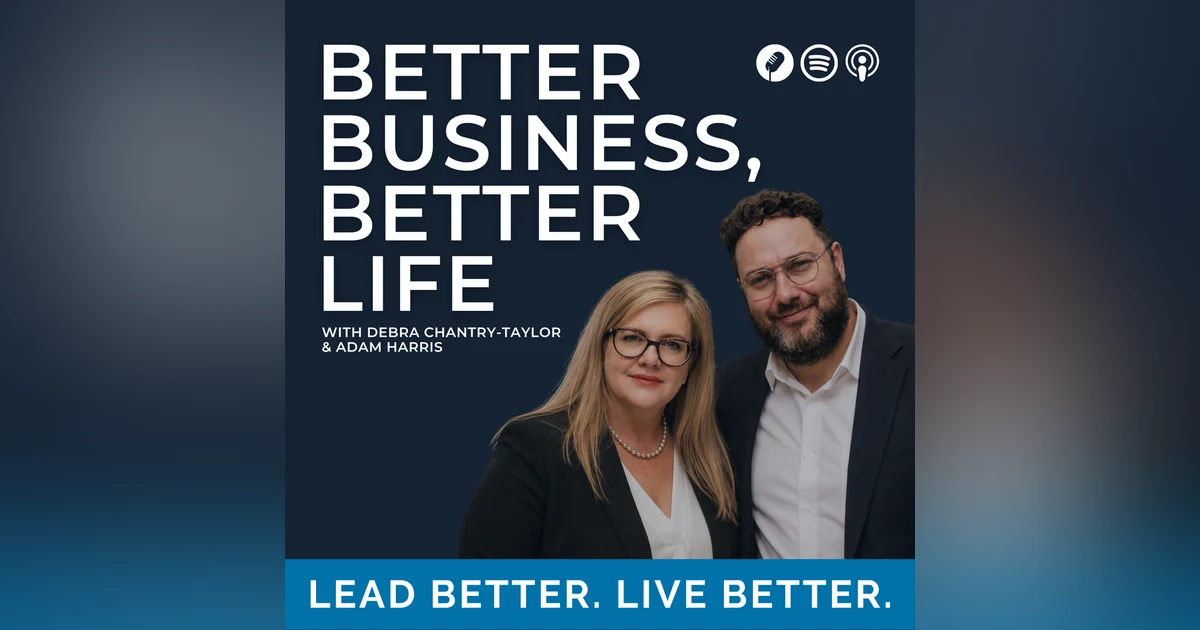
Debra Chantry-Taylor: Why Leadership Teams Avoid the Very Conversations That Would Unlock Growth
In this episode of Better Business, Better Life, Debra Chantry-Taylor tackles one of the biggest barriers to scaling: the conversations leadership teams avoid that could unlock growth.

 Spotify
 YouTube
 Amazon Music
 Apple Podcasts
 RSS Feed
 iHeartRadio
 PocketCasts
 RadioPublic
 In this episode of Better Business, Better Life, Debra Chantry-Taylor tackles one of the biggest barriers to scaling: the conversations leadership teams avoid that could unlock growth.
Debra exposes the “polite meeting trap,” where teams stay comfortable, avoid conflict, and leave meetings with no real decisions or progress. While it may feel safe, this behaviour quietly stalls growth and erodes accountability. She makes it clear that politeness does not build great businesses, effectiveness does.
The episode dives into why leaders avoid hard conversations in the first place. Fear of conflict, protecting relationships, and power dynamics all play a role. When the most senior leader avoids tough topics, the entire team follows, leading to side conversations, misalignment, and slow execution.
Debra explains how EOS provides the structure needed to make these conversations easier and more productive. With clear roles, accountability, and objective data, teams can separate people from problems and focus on solving real issues without emotion taking over.
She also shares practical strategies to shift from avoidance to action, including eliminating sidebar conversations, bringing issues into the room, and regularly assessing whether team members are aligned with core values and truly fit their roles.
If your leadership team feels stuck, overly polite, or avoids the real issues, this episode is a direct call to step up, have the conversations that matter, and create the clarity needed to grow.
CONNECT WITH DEBRA:
___________________________________________
►Debra Chantry-Taylor is a Certified EOS Implementer | Entrepreneurial Leadership & Business Coach | Business Owner
►Connect with Debra: debra@businessaction.com.au
►See how she can help you: https://businessaction.co.nz/
►Claim Your Free E-Book: https://www.businessaction.co.nz/free-e-book/
Episode 270 Chapters:
00:00 – Introduction
00:55 – EOS Thinking and the Importance of Honest Conversations
02:46 – The Polite Meeting Trap
04:17 – The Founder and Power Dynamic Problem
05:58 – The Role of Structure in Facilitating Hard Conversations
06:49 – Ad Lib Questions and Answers
11:44 – The Real Cost of Polite Meetings
13:59 – Structures That Make Hard Conversations Safer
15:43 – The Importance of Regular Reflection and Conversations
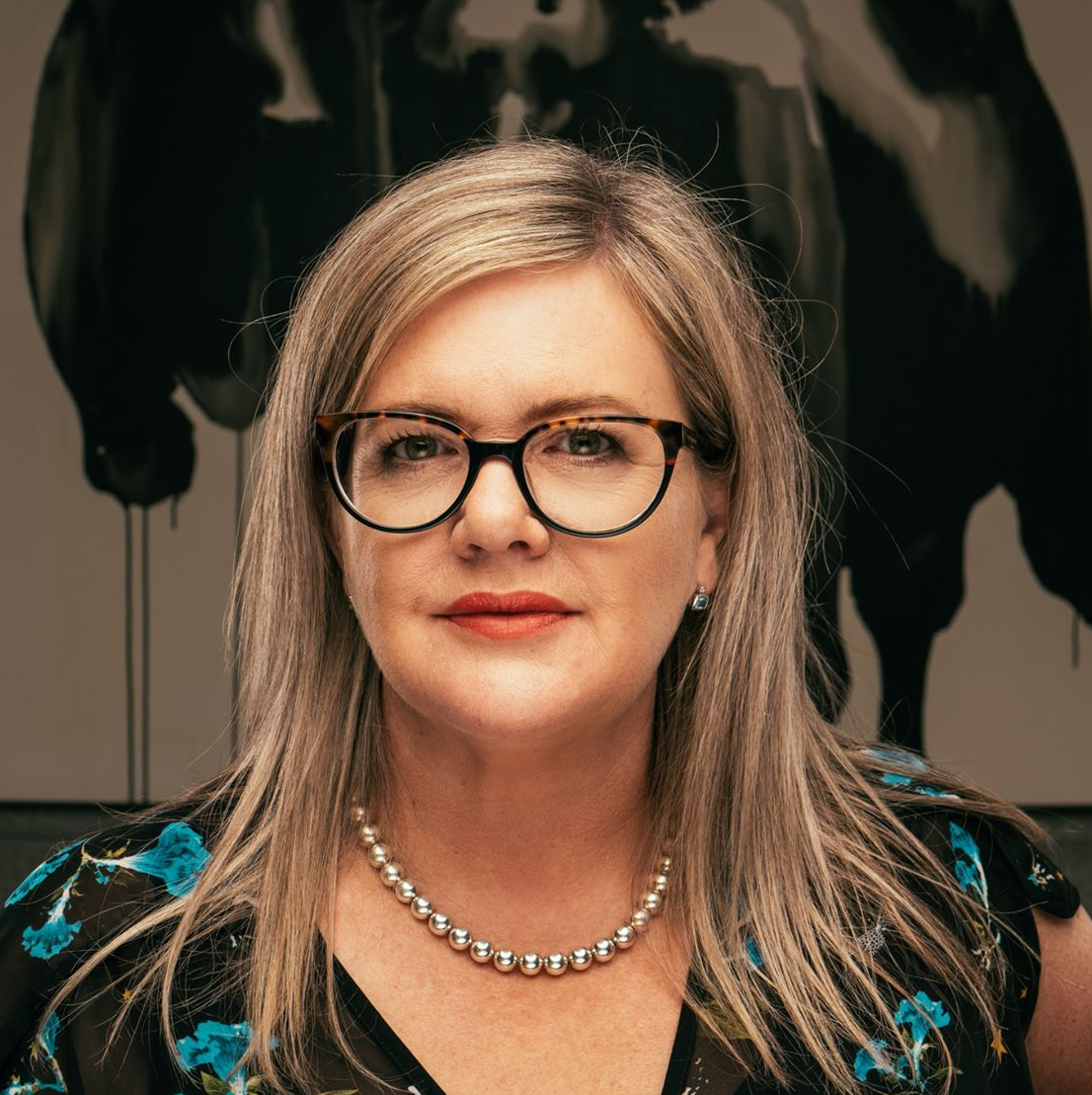
She is based in New Zealand but works with companies around the world.
Her passion is helping Entrepreneurs live their ideal lives & she works with entrepreneurial business owners & their leadership teams to implement EOS (The Entrepreneurial Operating System), helping them strengthen their businesses so that they can live the EOS Life:
- Doing what you love
- With people you love
- Making a huge difference in the world
- Bing compensated appropriately
- With time for other passions
She works with businesses that have 20-250 staff that are privately owned, are looking for growth & may feel that they have hit the ceiling.
Her speciality is uncovering issues & dealing with the elephants in the room in family businesses & professional services (Lawyers, Advertising Agencies, Wealth Managers, Architects, Accountants, Consultants, engineers, Logistics, IT, MSPs etc) - any business that has multiple shareholders & interests & therefore a potentially higher level of complexity.
Let’s work together to solve root problems, lead more effectively & gain Traction® in your business through a simple, proven operating system.
Find out more here - https://www.eosworldwide.com/debra-chantry-taylor
SUMMARY KEYWORDS
Leadership teams, growth, hard conversations, EOS system, family business, trust versus comfort, polite meetings, accountability, visionaries, one-on-one conversations, structure, core values, people issues, ownership dynamics, business scaling.
Debra Chantry-Taylor 00:00
This is where EOS thinking quietly shines when the system does the heavy lifting, truth becomes normal, not dramatic. If your business feels stuck or growth feels harder than it, should ask yourself this question, What conversation Are we avoiding right now? If you've ever walked out of a leadership team meeting thinking that was fine, and then absolutely nothing changed afterwards. This episode is for you. Hello and welcome to another episode of Better Business, better life. I am your host, Debra Chantry-Taylor, and I'm passionate about helping owners and their leadership teams create a better life by creating a better business. I am an EOS implementer, family business advisor, and just somebody who loves having frameworks and tools are simple and pragmatic to make things easier. So in my last couple of podcast episodes, I've talked about the science of scaling, and I've talked about some of the things you need to do if you generally want to scale your business. I've also talked about the fact that you can be bigger and better. But today I'm going to go even deeper on this, and I'm going to talk about why leadership teams avoid the very conversations that would unlock growth, or in other words, how to stop being so polite and start being effective. So let's get honest. Let's talk about the thing that everyone knows is there but pretends not to see. If you've ever walked out of a leadership team meeting thinking that was fine and then absolutely nothing changed afterwards. This episode is for you, because most leadership teams are very good at talking. They're just very bad at saying the one thing that actually matters, and not because they don't know it, because saying it feels uncomfortable. But let's be truthful here, growth does not happen without discomfort. So the real conversations that get avoided leadership teams don't avoid hard conversations because they're weak. They avoid them because they're human, because hard conversations trigger things like fear of conflict, fear of being disliked, fear of damaging relationships and fear of opening something that they can't close. And the longer people have worked together, the stronger those fears get, especially in businesses with long history shared ownership or family involvement. That's the Harvard three circle family business model, quietly in the room, business ownership and family, whether it's acknowledged or not. So leaders choose harmony over honesty, and as a consequence, growth quietly stalls. And it's not just in family businesses, it's in any business I've been going for a while and with teams that have been working together for a long time. So let's have a look at how we can actually change that. Let's talk firstly about the polite meeting trap. Let me describe a meeting and tell me, if this feels familiar, everyone's on time. The agenda looks sensible. The numbers are reviewed. People say things like overall things look Okay, a few challenges, nothing major. Oh, yeah, we'll keep an eye on that. No tension, no raised voices, but also no clarity. Either. The meeting ends, nothing changes. And that's not a leadership meeting, to be honest. That's a performance. And polite performances do not scale businesses, I get in trouble sometimes when I run sessions because of my bluntness. But the reality is that, you know, a lot of the teams I work with, they're not really leadership teams, and they're not running leadership meetings. And it doesn't mean they can't get there, and it's always my goal to try and bring them up to that, but you cannot do it by just being polite and holding these meetings that are completely ineffectual. So let's talk about trust versus comfort. And here's a leadership myth that is really worth killing. We have a high trust team. Often, no, that's not true. What you have is a low conflict team. High trust teams can disagree without falling apart. Low conflict teams just avoid saying what they're really thinking. And if people only speak honestly, one on one, but not in the room, then that is not trust. That's fear dressed up as harmony and growth hates harmony without truth. We talk about the sidebar conversations. We talk you know, I've been in meetings where I know that people have sat there and they've just nodded and they've agreed because they feel that's the easiest thing to do. Then, you know, as soon as they walk out of that room, they don't agree, and they're going to go and they're going to have a sidebar conversation with somebody they are not on board at all. So let's talk about why this happens, the founder and the power dynamic problem. Here's something really subtle, but also really important. When the most senior person in the room hasn't spoken, no one else really will, even if they're thinking it, especially if they're thinking it, and that's not ego, that's physics, if the leader avoids the hard conversation. The team will too, because leaders, leadership teams, don't have a courage problem. They have a permission problem. People need to see that honesty is welcome and that it's safe. So why do leaders prefer one on ones? I hear this all the time. Let's take it offline. I'll just deal with it one on one. And why? Because it feels easier, it's quieter and it's less risky. But here's the problem, growth limiting. Issues don't belong in private conversations. They belong in leadership forums. When issues get handled in the corridors, coffee chats, one on ones, alignment never truly forms. You get side agreements instead of shared decisions and scaling stalls. And I've seen it a lot with visionaries. You know, they don't want to have the hard conversations in these leadership meetings, and so instead they go and have one on one conversations. But the problem is that, first of all, that means the team is left out of it. And secondly, it's also encouraging people to keep going back to that founder, back to that visionary all the time, rather than actually being held truly accountable for what their role is. So here's the good news, structure can make those hard conversations easier, because you don't need more courage, you actually need better structure. And hard conversations are easier when issues are separated from people, when data is objective when roles are clear and when priorities are absolutely explicit. And this is where EOS thinking quietly shines. When the system does the heavy lifting, truth becomes normal, not dramatic. The beauty of the EOS system is it gives you all of these frameworks. It's not cookie cutter. It's not about this is the way you must do it, but it gives you everything to help take the emotion out of it and to get us focused on the real things. So the growth question that truly matters, if your business feels stuck or growth feels harder than it, should ask yourself this question, What conversation Are we avoiding right now? What is the elephant in the room? What are we sweeping under the rug? What do we know is huge and could really make a difference, but we're not dealing with it, because that's usually where the growth is hiding. And let's face it, if you can create growth in your business, create a better business, you get a better life, not because you are nicer, but because you are honest. So again, I asked d2, my chat, G, P, T, to give me 10 ad lib questions that I have not read because I like to do them completely ad lib. And so I'm going to go through those 10 questions here now, and I'm just going to answer as things come to my head. If you've been listening to our podcast for a while, you know that I think fast, act fast. I'm not giving you theoretical or academic answers here. I'm just sharing with you what I actually know to be true based on my years and years of experience and working with lots of different teams. So let's start with question number one. What's the most common conversation leadership teams avoid?
Debra Chantry-Taylor 07:59
I'm not sure there's a most common conversation. I think in general, it goes back to what I said just earlier in the podcast. Is that because they haven't been given permission to be really open and honest and vulnerable, nobody feels comfortable doing it. And I think this is where visionaries tend to let the team down, because if the visionary can actually open up and be truly open, honest and vulnerable, it gives everybody else permission to actually do that. And if I had to pick one of the most common conversations that leadership team avoids is people issues nobody likes to talk about. And I'm talking about people issues with the leadership team in that room. You know, we've got to have the conversations. We've got to be working together for the greater good. And sometimes it's really hard to have a conversation about somebody who is your peer on a leadership team, but we have to. We have to make sure we're there to support each other. We're also there to challenge each other as well. Question number two, how do nice teams accidentally block growth? Well, they accidentally block growth by not having the difficult conversations. They're too nice to each other. They don't want to be held each other accountable, and they don't want to challenge when they can see that things are off track, but they don't want to challenge it because it's not their area of accountability. But again, a true leadership team is there for the entire you have the greater good of the entire business. So we actually have to have those conversations sometimes, whether you like it or not, the people who got you to where you are now are not the people who will get you to the next level, and you could have one person on the leadership team who's actually holding the rest of the leadership team back. So it's really important that we actually have the difficult conversations about people. Number three, when does loyalty become a liability in leadership teams? Oh my goodness, it often becomes a liability, and leadership teams the amount of times that I've heard. But you know, this person's been with us for 15 years. They've been really loyal. I don't want to let them go. And you see it from an outsider looking in, because that's what I am really you see that they're just not doing what they need to do. They're just not at the level that they need to be. And. So as a consequence, you've got somebody who, you know, we think we're doing them a favour by keeping them on, but we're actually destroying the company and its ability to grow. But let's be honest, we're also destroying them because maybe they're not enjoying the role anymore either. Maybe it's time for them to actually do something different, whether that be in your business or somewhere else, because they're just, you know, they're they're probably busy, they're probably overwhelmed by doing all these things, because they're just not capable. Just not capable anymore of doing what the role actually requires. So unfortunately, yes, loyalty is one of my strongest values. We know loyalty is really important, but not when it comes to business. When it comes to business, we need to make sure, and sorry that sounded wrong, that we love, that people are loyal to the business, but not when it comes to the business operation, the business structure, the business accountability. We need to make sure that people are in the right seats, doing the right things, that they're working within their unique ability. They're doing the things that they love and they're great at that is the most important thing, way beyond sort of loyalty. Question number four, how do family or ownership dynamics make honesty harder? Well, I would have thought this is pretty obvious. I mean, if you think about family or ownership dynamics, it's just another set of dynamics. You've got your business dynamics in terms of who's accountable for things, but then all of a sudden you're sitting in a room where you've got your your husband, your wife, your father, your mother, your brother, your sister, your uncle, your auntie, your cousin, and they, you know, you've got another dynamic with them in the family, which means that suddenly you've got to be really, really clear that I'm not wearing the sister hat anymore. I'm wearing the business hat. And that's hard, because you've still got to have dinner together at the end of the day. You've still got to go back to that things. But what I love about the EOS framework is it gives you the real clarity around that to do it. The ownership dynamic thing is another thing altogether, where people kind of go, but you know, I own the business, I should have a say. Well, yes, you have a say in the owner's box in terms of the long term, the long term strategy of the business, but in terms of the day to day running, we've got to give people full accountability in the leadership team to run their department. And if you don't give them full accountability, and you keep coming in with the ownership card, then you're going to prevent and hamper growth in the business. It's that simple. Number five, what's the real cost of polite meetings? The real cost of polite meetings is nothing will get done, nothing will change. And if nothing changes, nothing changes. So what is the real cost of it? You are, you are doing yourself and your business a disservice. You are hampering your growth. You are stopping yourselves from getting where you can be. And then the real cost of that is, you're, you're stopping yourselves from making the huge difference in the world that you could be making, and the number of people you could help and the number of people you could serve. So you know, you might think it's just about being polite, but in actual fact, you're ripping off the world. You're not letting them get on with, you know what? You're not letting everybody get on with. What needs to be done for us to truly add the most value in the world. Number six, how does a CEO or founder set the tone for truth. They've got to be leading it. They've got to be open, honest and vulnerable themselves. They've got to be prepared to have the difficult conversations, because the rest of the team is looking for permission, not in terms of asking Is it okay? They want to see it's a trusting, open, honest and safe environment. And so as a CEO or the founder, you've got to show them that it is a safe environment and they can be open, honest and vulnerable. Number seven, why do leaders prefer one on ones over team conversations? Because it's tights hard. It's hard to bring these things up in a team environment. It absolutely is. It's so much nicer, so much kinder to do it in a one on one environment. But it's not really, it's not Kinder at all. In fact, it's, it's doing a disservice. So that's why it's done. It's easier. It's it feels a whole lot easier to do. But it is not gaining alignment with the team. You have to have the conversation with the team. So everybody's on the same page. We all know what's going on. We all know what the boundaries are. We're all supporting Heather to achieve number eight, what structures make hard conversations safer? This just comes down to our accountability chart, you know, having a really clear understanding about who is accountable for what, and then the things that tie into that, what do they have in terms of financial, delegated authority, what decisions are they able to make? What are they truly accountable for? Because then you can have the hard conversation. You know, if they know what they're accountable for, they know what their scorecard measurables are. They know what their rocks and their priorities are. They know what systems and processes they are accountable for because of that accountability chart, then we've got the boundaries. We've got the rules of the game. I talk about the rules of the game all the time. We know how to play. We know how to win. Now you know what those rules are. That's going to make the hard conversation safer, because suddenly it's not about emotion, it's not about people. It's about hey, we agreed these were the outcomes that we needed. So why haven't we got there? We agreed that this is. The system and the process was supposed to follow. So why aren't we doing it? We agreed that these were the rocks or the priorities for the quarter that we had to do. So why haven't we done them? So all of this structure in the Eos frameworks makes these hard conversations safer and it makes them less emotional. Number nine, how do you stop issues being talked about around the room instead of in it? Well, I know how I do it. I do it by making it the rule. There is to be no sidebar conversations. Every conversation gets held in the room. And if you catch somebody having a conversation outside of that room, you bring it to their attention. You hold them accountable. You tell them this is not how we do things around here. You bring it into the meeting, and then you ask the question. You say, hey, look, are you going to tell them, or am I? Because if you don't bring it to the leadership team meeting, then I'm going to do it myself. Always a great question to ask gets people thinking about, Okay, I think I probably should do this and take account of myself. Number 10, last question, what's the one question every leadership team should ask regularly? I don't know if it's one question, but the one thing that I find is really helpful every once in a while is for the entire leadership team to actually go through the people analyse it on themselves, and the rest of the team sitting around the leadership team table, I find that it is a real eye opener, both personally and for the team to actually go. Is this person living by our core values? If they're, you know, a plus minus or a minus. Why is that? And do they actually, genuinely G, W, C, the role? Do they get it? Do they want it? Do they have the capacity? Because as the business scales, as a business grows, as things change, maybe the people need to change too. And so having a good, honest reflection and conversation about whether you're still the right person. Do you still get the role as it now exists? Do you genuinely still want it, and do you have the capacity or capability to actually do it? And if there's a no on any of those, you've got to have that conversation. That's the elephant in the room. The leadership team who got you to a certain stage may not get you to the next stage, and that's what you should be asking yourself regularly, right? Gosh, it's always interesting having those thrown at me, but hopefully that has been helpful. If you're needing some help with some of this stuff, it is difficult, difficult conversations. I mean, I don't enjoy having them. I'll often say I'd much rather stick my head down a toilet than have this conversation with you, but I need to for the greater good of the business. But it is something that I have done a lot of work on over the years, and I've worked a lot of businesses over my six years as an EOS implementer, my 20 years as a coach, and my 30 plus years running businesses, I've had to learn about this stuff. So if you need some help, please reach out. I would be happy to help. My email is Debra at business action.com.au, or Debra at business action.co.nz, I'm here to help you create a better business so you can have a better life. Hope you've enjoyed the show. Look forward to seeing you again soon.

EOS Implementer | Entrepreneurial Leadership Coach | Workshop Facilitator | Keynote Speaker | Author | Business Coach
Debra Chantry-Taylor is a Professional EOS Implementer & licence holder for EOS Worldwide.
As a speaker Debra brings a room to life with her unique energy and experience from a management & leadership career spanning over 25 years. As a podcast guest she brings an infectious energy and desire to share her knowledge and experience.
Someone that has both lived the high life, finding huge success with large privately owned companies, and the low life – having lost it all, not once but twice, in what she describes as some spectacular business train wrecks. And having had to put one of her businesses into receivership, she knows what it is like to constantly be awake at 2am, worrying about finances & staff.
Debra now uses these experiences, along with her formal qualifications in leadership, business administration & EOS, to help Entrepreneurial Business Owners lead their best lives. She’s been there and done that and now it’s time to help people do what they love, with people they love, while making a huge difference, being compensated appropriately & with time to pursue other passions.
Debra can truly transform an organisation, and that’s what gets leaders excited about when they’re in the same room as her. Her engaging keynotes and workshops help entrepreneurial business owners, and their leadership teams focus on solving the issues that keep them down, hold them back and tick them off.
As an EOS implementer, Debra is committed to helping leaders to get what they want and live a better life through creating a bet… Read More