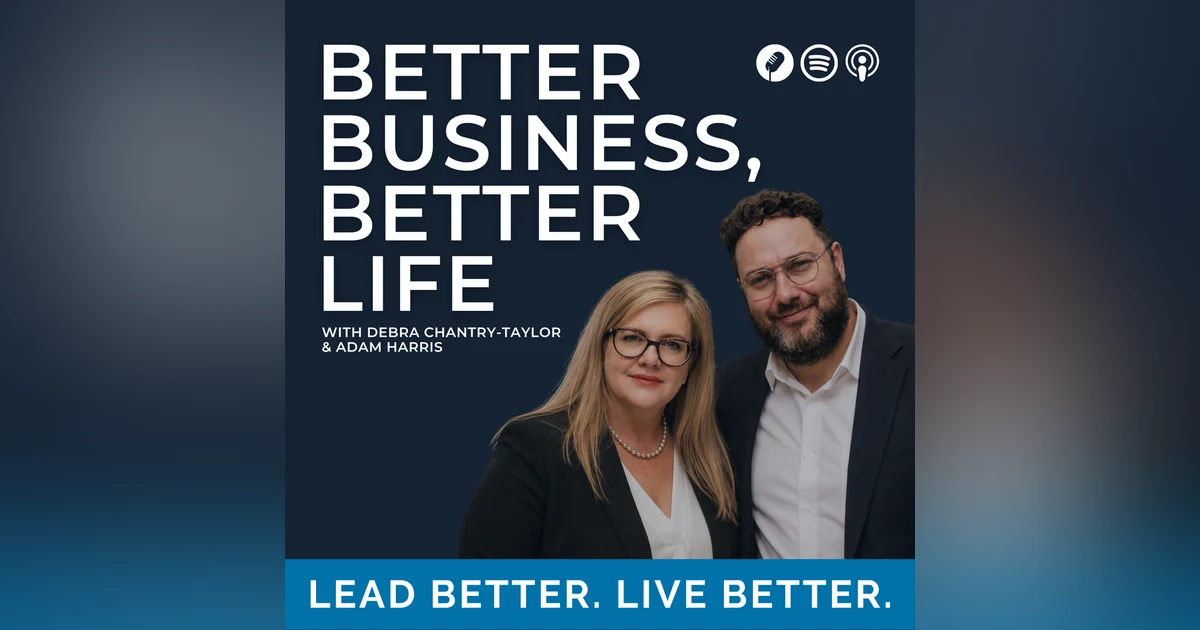
Adam Harris: Why Businesses Get Stuck (and What Founders Can Do About It with EOS) - Part 2

In this episode of Better Business, Better Life, Debra Chantry-Taylor and Adam Harris go deeper into how businesses get unstuck, moving beyond surface-level fixes to uncover the root causes holding companies back.

 Spotify
 YouTube
 Amazon Music
 Apple Podcasts
 RSS Feed
 iHeartRadio
 PocketCasts
 RadioPublic
 In this episode of Better Business, Better Life, Debra Chantry-Taylor and Adam Harris go deeper into how businesses get unstuck, moving beyond surface-level fixes to uncover the root causes holding companies back.
They explore why so many businesses face the same issues again and again, and why most teams jump to solutions too quickly without properly identifying the real problem. Using tools like the EOS Issue Solving Track (IDS) and simple but powerful W questions (Who, What, When, Where, Why), they explain how to dig deeper and solve issues properly the first time.
A major theme in this conversation is clarity. Without it, teams become reactive, communication breaks down, and founders feel increasingly overwhelmed as the business grows. Debra and Adam highlight how lack of clarity around roles, expectations, and outcomes leads directly to stagnation.
They also discuss the importance of accountability, structured meetings, and consistent practice. High-performing teams don’t just talk about issues, they build the muscle to solve them through repetition, trust, and open, honest conversations.
The episode also tackles tough topics like having the wrong people in key roles, unproductive meetings, and early warning signs that a business is losing traction. Founders are encouraged to step back, take a clarity break, and seek external support such as coaches, mentors, or peer groups to gain perspective and momentum.
If your business feels stuck in cycles of the same problems, this episode provides practical tools and mindset shifts to help you regain clarity, fix root causes, and move forward with confidence.
CONNECT WITH DEBRA:
___________________________________________
►Debra Chantry-Taylor is a Certified EOS Implementer | Entrepreneurial Leadership & Business Coach | Business Owner
►Connect with Debra: debra@businessaction.com.au
►See how she can help you: https://businessaction.co.nz/
►Claim Your Free E-Book: https://www.businessaction.co.nz/free-e-book/
___________________________________________
GUEST’S DETAILS:
► Adam Harris – LinkedIn: https://www.linkedin.com/company/adam-harris-eos/
► Website – EOS Worldwide: https://www.eosworldwide.com/adam-harris
Episode 268 Chapters:
00:00 – Introduction
00:36 – Why Businesses Get Stuck: Introduction and Initial Thoughts
2:48 – Exploring the Root Causes of Repeated Issues
13:35 – The Importance of Teamwork and Practice
18:47 – Identifying the Wrong People in Key Roles
23:47 – Unproductive Meetings in Growing Companies
35:58 – Communication Breakdown and Reactive vs Proactive Behaviour
38:53 – Overwhelm Among Founders and Lack of Clarity
41:27 – Early Warning Signs of Businesses Losing Traction
41:39 – The Role of Lack of Clarity in Business Stagnation
44:28 – First Steps for Founders to Take When Recognising Symptoms
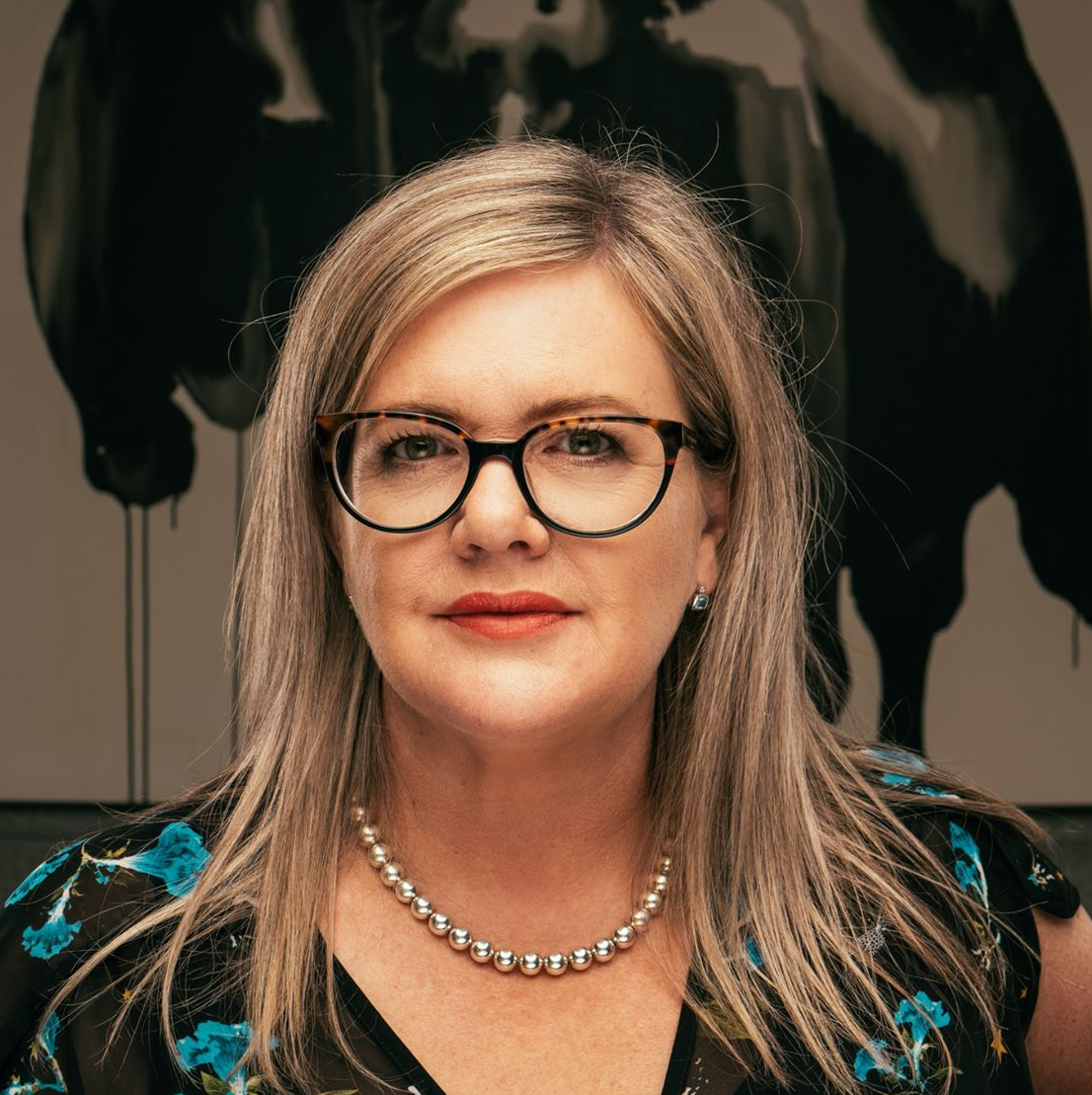
She is based in New Zealand but works with companies around the world.
Her passion is helping Entrepreneurs live their ideal lives & she works with entrepreneurial business owners & their leadership teams to implement EOS (The Entrepreneurial Operating System), helping them strengthen their businesses so that they can live the EOS Life:
- Doing what you love
- With people you love
- Making a huge difference in the world
- Bing compensated appropriately
- With time for other passions
She works with businesses that have 20-250 staff that are privately owned, are looking for growth & may feel that they have hit the ceiling.
Her speciality is uncovering issues & dealing with the elephants in the room in family businesses & professional services (Lawyers, Advertising Agencies, Wealth Managers, Architects, Accountants, Consultants, engineers, Logistics, IT, MSPs etc) - any business that has multiple shareholders & interests & therefore a potentially higher level of complexity.
Let’s work together to solve root problems, lead more effectively & gain Traction® in your business through a simple, proven operating system.
Find out more here - https://www.eosworldwide.com/debra-chantry-taylor
SUMMARY KEYWORDS
Business growth, leadership team, root cause, accountability, communication breakdown, clarity, proactive vs reactive, teamwork, meeting productivity, visionary role, exit planning, EOS framework, mastermind groups, clarity break, founders' overwhelm.
SPEAKERS
Debra Chantry-Taylor, Adam Harris
Debra Chantry-Taylor 00:00
The firefighting can also start to become a bit of a dopamine hit in terms of, oh yeah, we put that fire out. Oh yeah, we put that fire out. Oh yeah, we put that far out. As opposed to thinking about, I wonder why all these fires keep starting.
Adam Harris 00:10
I often talk about the the aspect that is, if we're not having those conversations, what we're actually doing is we're stealing from the company. Why are you having the meeting? Oh, I need the updates. Well, why do you need the updates? And more often than not, the updates is because there's a lack of trust.
Debra Chantry-Taylor 00:32
Hello and welcome to another episode of Better Business, Better Life. I'm your host, Debra Chantry-Taylor, and as you know, I'm passionate about helping entrepreneurs lead a better life by creating a better business. Today, we are continuing on from our last podcast, and I have my work brother, Adam Harris joining me here in the studio. Hey, Adam, hey. And we were talking last week about why businesses get stuck and what founders can do about it. And in typical Debra and Adam style, of course, we were able to chat away for way too long. So we had to split it into two podcasts. So we're back. We're back to talk more about it, and we have got 10 more questions that d2 our friendly chat GPT has put to us about why businesses get stuck. So welcome back, Adam. Great to see you again.
Adam Harris 01:15
Lovely. Always. Always a pleasure.
Debra Chantry-Taylor 01:16
It is always a pleasure. I mean, I hope everybody enjoys these as much as we do. I mean, we certainly have a lot of fun doing that. I'll be honest, I don't actually care. It's funny, isn't it, I had this realisation just probably about a year ago where I used to be very anal about the way that I did the podcast, and it's like, Oh, am I doing it right? And worrying all the usual kind of, you know, self doubt stuff, like, I'm doing it right. And then I went, you know what? I actually just enjoy talking to people. I enjoy asking the questions. And I figure hopefully, if I'm asking questions that I find interesting, other people will also find interesting. And if not, so be it because I'm having fun anyway. Yeah, and it
Adam Harris 01:54
kind of reminds me of a quote, which is, it's not my responsibility what other people think or feel, yep, like I agree, as long as you and I are in a good time and having fun and learning and reflecting and challenging our own assumptions, if other people take Randy, would benefit from it.
Debra Chantry-Taylor 02:12
Fantastic. Yes, indeed, indeed, and hopefully they do. I mean, we have a lot of experience between us and we also we enjoy. We love business, right? Business is a big game. I love the game of business. Okay, so we are going back to the questions that d2 our friendly chat GP has sent to us about why businesses get stuck and what founders can do about it. And so we had five questions in the previous episode, and also a whole lot of banter around what we think why businesses get stuck. Now we're going to get into some meaty questions. So question number six, Adam, why do companies keep having the same issues over and over again?
Adam Harris 02:48
Well, that's a great issue to be discussing as a leadership team. I mean, the quick and easy answer is, is that we've never actually got to the root cause of the root issue. So you know, again, if you always do what you've always done, you'll always get what you've always got. So often, find that teams. I found myself I'm in a loop, and it's like, if I don't find a way of breaking the loop, then I'm not actually finding out what the real problem is at the bottom. So you know, I can picture the video of you doing the L 10 with the kind of handwriting, and I could just picture you and beat you in my mind, go and dig and dig and dig and dig and dig. Keep digging, keep digging. And that's it. It's so true is that if you're not getting the output that you want is to just keep digging and find out what the real issue is. And I
Debra Chantry-Taylor 03:45
certainly see in a lot of the the level 10s that I observe and the IDs in that I see. So IDs, for those who are not familiar with Eos, is the issue solving, track. It means identify, discuss and solve. I see that a lot of people kind of want to jump straight to the solution. So they often even if they even pose the issue, we're already kind of proposing what the issue is. So sales have dropped, and it's because of marketing, as opposed to going, playing the curious child asking a question, just going, Hey, sales have dropped. I wonder what has caused the drop in sales, because if you actually reposition it as a question, it forces you to actually then start to delve deeper. And I think that often people do like they solve it at the surface level, or what they think is the issue, rather than being really curious and asking the W questions. So the W questions are, you know, the the, when did it start to happen, and why is that, and what impact is it having, and who is it affecting, and what impact is that, and why is that? And just keep going and going and going, digging, digging, digging, as I say my video, until you actually find the real kind of root, root, the root cause, yeah, because then you can start to deal with that. So rather than just putting a band aid on it, you're going, Okay, what is the real wound here? And how can we actually stop it from happening? So that's what I see, is that people just don't, don't go deep enough, and they they surface level deal with it, or they just. Don't actually ever bring the issue, real issue up. Yeah, and
Adam Harris 05:05
as you were saying that, I was just kind of thinking, often it's about a person, and that might be, you know, are they the right person sitting in the right seat? Or there's, you know, is there a values alignment? But actually, sometimes it's about accountability in the fact that, you know, if somebody is not achieving or doing what they need to do is to actually be challenging enough to kind of go like, I'm going to put an issue on Deb not completing to do or rock or something else, like again, if I can't and I don't feel comfortable in challenging you, then it's almost kind of like it's almost kind of the sheep in wolf's clothing, in the fact that we know that it's there, but we're not going to say or discuss it. And actually, I often talk about the aspect that is, if we're not having those conversations, what we're actually doing is we're stealing from the company. So by me not being open, honest, vulnerable, challenging the status quo, really, you know, saying what's on my mind, and putting my my, my own individual fear, assumptions or ego to one side in and I think sometimes it's a case of, you know you really need to, need to challenge the individuals. But sometimes it doesn't necessarily have to be forthright. I think sometimes, actually, there's a skill of knowing how and where and what to say. So if I, if I bring an issue and it's like, what's the issue? Deb not completing what she said she was going to do, potentially, there's trigger, trigger, trigger, exactly, whereas if I say, you know, the first instance might be, I'm wondering where you're at Deb with this project. So then the language is slightly different. Let's say, for example, it's been going for two or three weeks, and I'm still not seeing the progress. The issue may well be, I'm wondering the commitment towards this project where, where's, Where's, where's your issue? Deb, within this, what's the support the other issue may well be. Deb, what's the support that you need from me or the rest of the leadership team? So it doesn't necessarily have to be, you know, confronting. You can kind of come at it from that, you know, five, you know, the W's, or the the inquisitive, challenging nature, just go, I'm wondering, I don't know. I just need some clarity. And that then kind of opens the door. And, like, you know, soon as you've got that little bit, you can then kind of push through,
Debra Chantry-Taylor 07:42
yeah, I love that phrase, you know, I'm wanting, and I use it a lot, and I'm trying more and more to do that in my own sort of practice as well. It's like, Yeah, I'm wandering, as opposed to, because I can be a little bit German, a bit blunt at times, just going off a complete tangent. I watched the movie rush again last night, which I know that you and Naomi supplied blow up dolls for and, but it was really interesting. I'll come back to that in a second, but it was really interesting. And Nikki Lauda, he is. He's not German, he's Austrian, but he has that same kind of absolute rigour around, you know, questioning everything, but not quite in such a he's very, very blunt around the way that he does it in a movie. He comes across as being a little bit unpersonable. That was a great word because of the way that he is so blunt. But it, I know it comes from a place of wanting to do the best possible thing.
Adam Harris 08:29
Oh, absolutely. And he's still, I believe he's still involved in Formula One now, like with a
Debra Chantry-Taylor 08:34
no, he died. He died. He died at 70. But yeah, he was, he was, he was a three times kind of world champion. He's the most successful f1 driver who actually went on to form an airline and be an amazing entrepreneur. Actually, really, really interesting story.
Adam Harris 08:49
Yeah, he just had this innate ability to just, he was always thriving to be that point, 000, 1% better. You know, you can't, you can't do 1% in Formula on because the margins are so small. But, yeah, that that that rigour, that attention to detail, that challenge of self, but also of others, was really, really
Debra Chantry-Taylor 09:11
clear, yeah, and it was fascinating, like watching the movie again. You know the difference between him and James Hunt? I mean, James Hunt was the Playboy. You know, he'd be out partying, having sex, doing drugs the night before a race, and still race amazingly. But when you see how Nicky came back from, you know his crash, and the fact that he was back in the car just a few weeks later and winning races again in the future, like that man was driven on, what boy was he ever driven? And I think that James Hunt, kind of he ended up not having all that great a life like, in terms of once he'd finished his one win, I think he went off the rails a wee bit, and didn't actually become very successful. So it was, anyway, fascinating. But tell us about the blood dogs. Just complete, complete Off, off
Adam Harris 09:51
track thing. Yeah. So my my brother worked in the TV and film industry, and he worked for a couple of production companies, and. And there was this one project, I think it was, they were filming on a train, and he needed to get some extras. And the challenge with, by with getting human extras is a you've got to pay them, you've got to feed them, you know, they need all the facilities. They need managing as well. So he was like, surely, there must be a better, better option than this. So he couldn't find one. So he decided to, you know, and funnily enough, my brother was not necessarily that entrepreneurial, but he had this idea. So he created this business. We're supplying inflatable extras. So we used to have this phrase, which is, don't blow up the budget, blow up an airhead. So we were involved in a number of differing films and TV projects across the UK and Europe. Had a lot of fun and them, and I got involved. And it, you know, you know me, I'm just kind of an opportunist. It just, it took us to some really interesting spaces. So Naomi led the project on the on the rush film, which was directed by Ron Howard.
Debra Chantry-Taylor 11:12
She was telling me on the weekend, yeah, you know, to
Adam Harris 11:14
so to spend time with him. I don't think Naomi necessarily realised it at the time. But, you know, Chris Hemsworth was, you know, played James home. Yes, I had noticed, I would say at that time he wasn't as ripped as he is now. But, yeah, just being, being on a film set, it's a completely different. Things are just done very, very differently. And I, I love the experience of just just going and kind of getting involved.
Debra Chantry-Taylor 11:45
Yeah, Naomi was sharing with me a few of the stories from the rush film as well. But it was really, it was really good. It was good to hear her stories and actually watch the film again. Anyway, that was going completely off track, but I'm going to actually be writing a whole bunch of articles around because I don't know if people are aware, but I have been a Ferrari girl since I was really, really young. My father used to go off to the European car shows, and he would come back with pictures and models of Porsches for my brother, because he was a Porsche fan, and he'd come back with pictures and models of Ferraris for me. So really, in my real early days, my entire wall was covered with pictures of Ferraris. I had Ferrari models, and I've now, because I'm single again, and got my own bedroom back. I've now got a Ferrari collection in my bedroom now as well, because it's like, Yep, I've always been a bit of a Ferrari girl. So I've been thinking about the I always talk about business as being a game and it but it is a precision game, and so when you compare it to kind of the f1 of the Grand Prix and the way those teams work together, there's lots of analogies that I've got to be able to come up with. So I'm writing a series called Lessons from the fast lane, which I'll be launching the next couple of weeks.
Adam Harris 12:43
So let's not move on without you sharing, because you went to the f1 in Melbourne at the weekend. How was that for for a Ferrari girl, ah, I
Debra Chantry-Taylor 12:52
mean, unfortunately, we didn't come first. We only came third and fourth. But, I mean, we didn't have great seats. It was just a general admission ticket. But I have to say, being in that crowd, being a real petrol head, although they're only 50% petrol now, but be a real petrol head. And just that, the sound of the engines, the sound of the crowd, the first nine laps were just amazing. There was so much overtaking and so much drama and whatnot and so and every time there was an overtake or or some kind of drama, the crab went absolutely wild. I was absolutely like a pig and shit, if I'm honest. And of course, I was, I was gonna get, I wasn't gonna buy any merchandise. It's like, No, I'm not paying ridiculous amounts for merchandise. But I, I acquiesced, and bought a Ferrari hat and a Lewis Hamilton Ferrari car for my collections. Yep, I was like a pig and shit. It was a lot of fun. And again, like just seeing, you know, when you watch those pit stops. It's phenomenal, right? How that's teamwork. The fact that they can get that car in and out in a fraction is just unbelievable. So yes, very much. Enjoyed it. Thank you for asking. And in fact, that's really interesting. Oh, question number seven is this? Because I haven't seen these questions, but this is really interesting. Question number seven says, Why does some teams move fast while other parts of the business constantly struggle? Yeah, and
Adam Harris 14:07
I think just goes straight into that, which is teamwork, the reps, the challenge, the rigour, the consistency and working through each one of those individually, not becoming complacent. You know, I feel it's one of the reasons why we spend so much time working on that teamwork aspect, you know, to create that, that healthy, healthy conflict.
Debra Chantry-Taylor 14:33
And I think it's also around that, if you think about the examples of the the Pit Stop crew, like they, they all know what the end goal is, right? They are all absolutely aligned to what their end goal is and what they're trying to achieve. And they're all very, very clear about the role they play. I imagine if you had a pit stop team where you wouldn't show which tire you're meant to be putting on, and you will rush to try and change the front right tire all at the same time, that would be. A bit of an issue, right? And so I think that's one of the things around it, is, if you know, teams that move fast, they've got that clarity about where they're headed. They've got the clarity about the outcomes. They know exactly what role they play in actually achieving those outcomes. They've got the processes that ensure they can actually deliver them, and they're being measured, and they're refining all the time. Whereas the business that the parts of the business that I see going slow or constantly struggling is where they're trying to be a bit of everything. Everybody does a little bit of everything. Everybody tries to be helpful and supportive. But in actual fact, they're just not clear around what has to be done, and they're not holding each other accountable and calling each other out when, when things aren't going well, they're too nice in some respects.
Adam Harris 15:41
Yeah, I think also practice is such a key part. So I similar to kind of Eos in the IDS ing, is that, having run mastermind groups for, you know, 10 plus years, is we run a similar thing, you know, like issue processing, very similar to kind of IDs, and it's kind of like a muscle in the fact that when you're when you're using it is that you you know and understand. Let's get to the root cause. Let's peel away the layers. Let's find out what the real issue is. And what I observed, which was really interesting during covid, but actually during now, the situation with, kind of like, you know, with Iran and the Middle East, is those individuals and teams that are used to having, having the practice and the challenge of processing issues, problems and opportunities, is that as or when something big happens, it's like, oh, okay, it's just Another issue, you know, how are we, how are we going to deal with it? What do we need to what do we need to do? And that muscle is so taught that, you know, you're able to then work through whereas companies that weren't or aren't used to using that muscle, they kind of go into a kind of a bit of a blind panic, because, you know, the situation is very different to the norm, so they don't know how to deal with it. So for me, practice is really important. It's true.
Debra Chantry-Taylor 17:08
You're absolutely right. They build that tenacity from practice. And it's a little bit like, you know, you and I were talking before the podcast about the fact we have personal trainers, and we go to the gym regularly. And it's like, not that we're always particularly good at it. We fall off the wheel sometimes, or off the waggon sometimes as well. But it's that building that muscle. Because if you can build the muscle, it's amazing how quickly can actually come bounce back, even if something happens. Whereas if you haven't done that practice and those reps and doing all the building of the muscle just becomes you can't, you can't build muscle overnight. It takes a while, and so you've got to have been doing on a regular basis to actually better deal with the issues as they come up.
17:43
It's a little bit like bamboo, isn't it?
Debra Chantry-Taylor 17:44
Deb, yeah, it is. Yep. The bamboo story, shall I tell it again? Yeah. So the BAM, the bamboo story is kind of interesting. There is this particular type of Chinese bamboo that when you plant the seeds, it actually takes six to seven years before those seeds actually start to sprout. And the challenge is that you can't see anything happening, and so you're watering it, you're feeding it, you're talking to it, you're hoping that it's going to grow, but if you kind of try and dig it up to see if it's sprouting, you basically kill it. So you've got to just have trust and faith in the process that this stuff will grow. Once it sprouts at that six or seven year point, it goes ballistic, and it grows forever. And there's no stopping it, but you have to have some trust and some faith, and you can't stop watering it, and you can't stop talking to it, and you can't stop feeding it until it actually starts to sprout. So you're building up that the repetitions, so that when the opportunity arises, it will go absolutely crazy. Thank you. That's my pleasure. Okay, next question, how can you tell if you have the wrong people in key roles? Well, the first thing
Adam Harris 18:53
is, is if you're asking yourself the question, I've often worked on this basis, but denial is the first sign of admittance. So you know, if you don't believe you've got any, I mean, I feel that, you know, in a recruit, a really good friend of mine, and he was a client, actually, Steve Brown, who had a recruitment company, or has got a recruitment company in the UK, he talks about, you know, you should always be analysing and reflecting on your first your first team and also your bench. So you know what he talks about there is, is that you never know a situation that's going to happen with you know some of your A players. So you should be knowing that at any one moment, if you need to one of your A players is either going to leave or retire or whatever happens with them, is that you've got one or two people lined up. You've already had the conversations with them, you know, okay, cool. If Jane leaves, it's not a problem, because I've got Peter and and Sarah. I've already spoken to them. I already know that they get it. They want it, and they've got the capacity already know that there's, you know. That there's the, there's a core values match, so you're, you're kind of prepped and ready. So that's, that's an important thing to think of. Um, I feel that the other thing is, you should be reviewing and having the conversations as a leadership team all the time, because if you're not, then you're going to get stagnated fast and quick. I believe that in order to get the best out of people, we need to be kept on our toes. So a little bit kind of going back to the kind of the personal trainer aspect, is that, you know, and I know you've heard me say this before, our bodies and our minds will take the path of least resistance. So human nature dictates that fundamentally, apart from point 00, 1% of the population, most of us are lazy, consciously or not. So we get into, can we get into a rhythm and we get comfortable? And actually, if, if I, or the team are have got that kind of, you know, that just slight edge, and I, I know I'm going to go into a meeting and I'm going to be challenged, keeps me on my toes. Means that I need to perform better. It means that I need to be at the top of my game, and if I'm not, I know that I'm going to get pulled up on it. That's important.
Debra Chantry-Taylor 21:13
It's interesting just thinking or reflecting while you were talking some. One of the other things, I think you kind of know when you've got the right people, and odd is that they are really happy to consider being replaced at some point as well, and so therefore, they're actually also writing down their core processes. They're sharing their knowledge. They're bringing the next person in their team up so that when they are ready to move on, they've got somebody else there. So one of the warning signs for me is when somebody doesn't want to do that, when they're like, Oh no, they keep all that knowledge themselves. They keep all that they hold the reins. They're trying to protect their patch. It's a bit of a red flag in terms of that means that they're probably not actually the right person, because everybody should be thinking about where they move to next, and how they bring their own people up to to take on board. Because it's freeing to know that you can actually, when you're ready, and you no longer GW, see it, get it one to a capacity to do it. You can actually go and do something else, and somebody is ready to
Adam Harris 22:14
take over, yeah. And you kind of move away from the personal you're moving away from it. It's about me in the fact that actually the business is it's an entity in its own right. It's got its own heart. It's got its own, you know, soul. It's got its own core. We talk about that often. So when I know that the business is bigger than I am, then I'm kind of able to kind of let go. And, you know, one of the fee thing, one aspect which is really important is, is that you know every person I often say is your sole responsibility is to make yourself redundant. You know that we talk about the aspect of the delegate and elevate tool is the fact that if I'm able to delegate roles and responsibilities through that, the other the people underneath have taken a step up that allows me to then take a step up to then go, okay, cool. Where and what could I? Should I do? I want to be doing, to be adding value to this organisation. Great. I'm now able to step into a different space. And if, if I'm in that sweet spot of adding value and also getting huge enjoyment at the same time, then it's going to be great, but also may well be the case of kind of going okay. I've reached my limit, and that's also fine because I step away knowing that I'm leaving the team, the the people behind me in a better place than
Debra Chantry-Taylor 23:34
when I started, perfect. So I think the key thing in all of this is if you if you're even asking yourself the question that there's probably an issue there, and it's worthwhile exploring and find exploring and finding out, is the issue them, is the issue you? Is the issue? Whatever it might be, stick on the issues list. Have a discussion around it. Okay? Number nine, why do meetings in growing companies often become unproductive? You could take this one first. Okay, I think, and I've seen this with a lot of my client No, sorry, I don't think I know. I've seen it with a lot of companies. Is that, in the beginning, whether they're self implementing EOS or doing Eos, or they will follow the level 10 meeting agenda, which is very specifically designed with a certain philosophy, philosophy and flow, and they will follow it to the letter to the letter to start off with. And then over time, they drift and they start adding in their own little bits, or they start skipping over bits, or they start jumping into issues when they're in the scorecard section, for example. And what happens is, it goes back to the way meetings were before you had level 10 meetings, which is really just a bit of a chat fest. And so the lots and lots and lots of discussion, very little focus on the outcomes, on the scorecard, on where the business is at, what the issues, opportunity challenges are. And they start arriving a little bit late. They start finishing a little bit late. They start just having really great chats, but not an awful lot of action. And so they go back to, yeah, ineffective mood. Meetings. And sometimes it's like a again, I'm going to use the car analogy. You need to come in, do a pit stop, fine tune things, get back to the way things should be, and then you're going to get back to the productive meetings. There's a really good reason why level 10 meetings work. I struggled in my own business in the beginning bringing them in because they are quite rigid. They are quite structured. But now I actually attend. I attend two per week for the two businesses I'm involved in, and they're gold. You know, I love them. I don't ever dread the meetings. I look forward to them. I know that they're gonna be done in a maximum of 90 minutes. I know they're gonna have a whole bunch of stuff that comes out of it that will be action oriented, yeah. So I think that's what I think things just drift over time.
Adam Harris 25:36
Yeah. The only thing I would add is, is the there's an aspect around trust. And if often I've I've found over the years, is that you go into a team, or you have conversations with the leaders. It's like, so why are you having this meeting? I think that's a great question to start with. Why are you having the meeting? Oh, I need the updates. Well, why do you need the updates? You know, and more often than not, the updates is because there's a lack of trust. And this goes back to, you know, within any Eos, the tool that we would use would be the accountability chart. Is that it Debra. If you're accountable for x, I should have 100% trust and faith that you're just going to deliver any updates that you feel that I need, a, you should be giving to me, or B, if I've got anything I need to ask, is that I can ask you. And I just found is that it's like we're talking about the same stuff. It's just we're wasting, we're wasting time, you know? And I often say to people, right? Okay, what's, what's the value that you've got to be sat in this meeting, you know? Let's put a figure on it, you know. And we start getting into the 1000s pretty fast, pretty quickly, it's like, so what's the output been from this conversation? Like you're just repeating, you're going over the stuff that you know, you're not adding in. There's no value being added. It's just because I need to bring you up to speed. Oh, my God, let go. Girl. I think one of my challenges has been over the years, is that I trust too much. I have stuff over without sometimes kind of communicating
Debra Chantry-Taylor 27:10
through it's called abdication, not delegation.
Adam Harris 27:14
Yeah, I own that. I own that. So if, if you're looking at your if you're if you're listening to this, and you're looking at what's going on with your meetings, and you're not getting any output, you've got to challenge yourself. You've got to say, you know, if I'm not adding any value, if I'm not receiving any value, give people the permission. I know this is really challenging. Give people the permission to kind of go, Okay, I'm walking up. You know, this is not the best use of my time. And then, you know, the EOS tools, with the accountability chart, the people analyzer, you know, GWC, it's really important that we get the right people sitting in the right seats, because when we've got the right people sitting in the right seats, a, we've got the right structure for the organisation, and B, we've got people that are sitting in the right seats. We know, we trust that they're either able to do the right thing and what's needed, or B, they know that they've got the support from the rest of the team to ask the questions that they don't know the answers to
Debra Chantry-Taylor 28:14
perfect and just to be really clear, this, I use the same thing with my teams. I talk about the value of that meeting, and I always say that, you know, a leader, a true leader, part of the leadership team is worth about $1,000 an out of the business as a bare minimum, right? So if you do that maths, let's say you got five people on your leadership team, five times 1000 times an hour and a half is seven and a half $1,000 so every level 10 meeting that you're having has the value of seven and a half $1,000 so you have to question, did we get seven and a half $1,000 worth of value out of it? And you're right, getting updates on what's going on. That is not value. That is just micromanagement. It's ego, a little bit of ego. I think people love telling you what they're up to, but I always kind of go, I don't actually give a stuff what you're doing, as long as you're if you're living by our core values, if you're doing what your accountability chart says if you're getting the right outcomes and you're doing your scorecard measurable, getting your rocks done, I don't give a fuck what you're up to. Just just come you know, I'm going to question you when we're not getting those results. That's the only reason I would be inclined to question because I give you full
Adam Harris 29:14
accountability do it. I'd love for you to share the the table or the desk story.
Debra Chantry-Taylor 29:20
Ah, yes, this was a few years ago now, but I was working with a team, and I think there were six people in that team, and so you actually had a meeting. It's worth more like $9,000 for that 90 minute meeting, and they spent such a long time. Well, there's two things that if, first of all, they spent 45 minutes going through a spreadsheet that the accountant wanted to review, and it was boring as batches for me, listening in, but also 45 minutes to go through it, when he could have said, here's a spreadsheet beforehand. Have a look at it. And then, you know, this is the answer I require from you. And the second thing was, they spent almost as much time in another meeting, kind of going through whether or not they should buy sit stand desks for I think it was four or five people. Now, a sit stand desk is about $600 In New Zealand, right? So you're talking about that most around about $3,000 worth of desks, which we spent close to 45 minutes discussing whether or not we should actually buy those sit, stand desks. Now that should be a delegated financial authority thing. You know, if it was within your delegated financial authority, just go ahead or do it, or, better still, just put it on the issues list, solve it in a heartbeat, because it's not an issue that should be at the leadership team level. So I would suggest they should have pushed it back down to the team that actually looked after it, and only if they delegated financial authority wouldn't allow them to buy it. Then, then, then I'd be having a different issue on the issues essentially, why is our delegated financial authority so low? Because in all reality, we've just wasted $9,000 of our time talking about, you know, a few $1,000 issue. So yeah, that was my sit stand story, but also that spreadsheet, and that's another thing I find with meetings. Why are they unproductive? Like, what I like to treat level 10 meetings, a bit like a board meeting, if you want somebody to make a decision on something, but there's some information they have to review beforehand. Give them that information beforehand. So rather than sitting in that level 10, meeting all of us going for 45 minutes, line by line through a very, very boring spreadsheet, let them have that information and tell them what is the desired result that you want. And then do the IDS around that that desired result, not around the spreadsheet. I'm just looking
Adam Harris 31:21
at the elephant behind you. Oh yes, you know, representing the elephant in the room. How often are we not? Am I not having the conversation that needs to be had because I feel uncomfortable?
Debra Chantry-Taylor 31:37
Yeah, it's a tough one. And look, we're all humans, right? And we all, I always say that I'm very, very persuasive and so and also a little bit scary, right? Apparently, I got called. It got called by one of my clients, bossy and stroppy the other day. I took as a compliment, of course, but it was, I
Adam Harris 31:54
think that should be your new Debra stroppy bossy,
Debra Chantry-Taylor 31:59
because it showed for me. It's passion, right? It's absolutely passion to get to the greater good. That's why I get stroppy and bossy, is because I want them to actually, really get to that, that that real result, the stuff that will make a huge difference. But because I'm stroppy, bossy and passionate and very persuasive and a little bit scary, people will find it hard to bring things up with me. Now, you and I have a beautiful working relationship. You've never had an issue bringing anything up with me, but I do imagine from some of our other staff and whatnot, it can be quite difficult to actually approach me as the visionary, as the person who runs the business, to actually say, hey, Debra, this is actually your issue, or we're seeing something going on with you. It's challenging, right? Yeah, well, I love the way we talked about this earlier, but, yeah, there's always different ways of doing it, but be careful you don't trigger people too. Because if you do just come out and get very blunt and address the elephant completely head on, it can actually cause some triggering. And then you get people who are in the state who aren't able to have the real conversation that will help us get to that greater good.
Adam Harris 33:01
Yeah, and just a couple of others to add to that, I think, you know, you've got the elephant behind you. Often, a number of our clients will have toys. So often it's like, Hey, Deb, I'm picking up the elephant. You know, a couple of other ways to do it is say, Hey, Deb, this is a really challenging for me, but I need to go there. This is the issue, or for the good of the business, I feel that I need to bring this up. So you kind of got to find what's going to, you know, work for for you. And sometimes, you know, the toys are great because they add a little bit of a humour. It's almost about you need to find a way of disarming a yourself, in giving yourself the courage and the conviction to have and go where you need to go, but also being respectful and mindful of the person who you're you know, who you're going to be talking about, where the issue is, and as long as the intent is right, and as long as you think a little bit into your delivery, it should be taken in the right way. You know, often, what I've said is, is that if somebody gets, if somebody gets, you know, if there's a reaction, there's a reaction because they care, like, you know, if somebody doesn't care, they're all there's almost like, there's passive, there's nothing there. So as long as we can be open minded, respectful and trusting that, you know that. And it took, you can't get that overnight. It takes time to build that, you know. And again, if you for me, if I, if I look and feel into the teams that I've worked with over the years, sometimes teams get that within six to 12 months. Other times it takes a longer time and look. Sometimes it takes years, but you've always got to be feeling, I want to bring this up, oh yeah, but I can't. As soon as you feel that you've got to, you can't afford not to, because it will just become a bigger and a bigger and a bigger issue. And it might not be that issue is, it may well be something else, but you're, you're missing. The underlying behaviour, accountability issue, opportunity, you're kind of missing the chance to become better versions of yourself.
Debra Chantry-Taylor 35:11
So true. Okay, we've got to push on number 10. What are the early warning signs that a business is starting to lose traction,
Adam Harris 35:18
lack of commitment and attendance to meetings, not talking about the real things that need to be spoken about within the meeting, whether that be kind of scorecard or rocks off track,
Debra Chantry-Taylor 35:29
especially leading, leading indicators going off track, yep, not
Adam Harris 35:32
entering the danger zone, complacency. Other things are more important than than the, you know, the consistency, yeah, those are the things that came to mind you.
Debra Chantry-Taylor 35:44
Yeah, no similar. I mean, you can start to see that they're not achieving their kind of outcomes. They're not having the difficult conversations. People stop, yeah, stop coming to meetings, or stop participating in meetings as well, all those sort of things. Okay, so then, why did number 11? Why do businesses become reactive instead of proactive as they scale, I feel
Adam Harris 36:03
that that is about going back into type. So, you know, one of my observations of working with companies doing EOS is is that it's a very different way of doing things. And it's actually, it's a sense of being like there's a conscious awareness of being mindful, accountable, individually and collectively, to the team and to the business. So there's a very different way of being than the majority of people have been taught. So you've kind of, I feel that a lot of the times, we've got to unlearn what we've learned, to then become a different version of ourselves, to then be able to sit within within the EOS framework. So when that's not being done, it's very easy to just go back to type. It's a little bit like kind of you mentioned about, you know, the gym is when you're in a rhythm and a cadence and a consistency, that's great. Kind of goes back to the question that you asked before, is that when you when you don't have the regularity and the consistency, and the challenge is that you you revert back to what you know, and that's that, that's the say, it's a danger, but that's just again, I think it's a natural occurrence to just go back into type Yeah.
Debra Chantry-Taylor 37:24
And I think, I mean, there's an element in all of us that loves kind of solving stuff. And so the firefighting can also be start to become a bit of a dopamine kind of hit in terms of, oh yeah, we put that fire out, oh yeah, we put that fire out. Oh yeah, we put that fire out. As opposed to thinking about, I wonder why all these files keep starting. Yeah, okay, number 12. And this is a really interesting one, because I just read this and it's like, Why does communication breakdown in companies as they grow past 2030, people? Now that could be, you know, 100, 200 people. It is interesting that, because I it does break down. But I've you and I've also both worked with very, very large companies where that communication is actually better than companies that got three or four people.
Adam Harris 38:05
I think it's a very easy narrative and story to say is that when you get past X, you know, number of employees, number of sites, for me, there's an aspect of like, you know, this is a great issue to talk about as a leadership team. Is right? You know, first and foremost, we've got to see it, then we've got to own it, and now we need to, then need to kind of really look into it and kind of go cool. So consciously, what do we need to ensure that we do that communication is consistent, that everybody's on the same page, you know, those that follow the US framework makes it a lot easier, because, you know, the flow of information up and down becomes really easy. One of my clients, you know, they employ three and a half 1000 people in London. They don't have a problem with communication. So it's very easy to take the narrative of, oh, when you get to x, this is what's going to happen. Well, why? That's kind of that. That's an old way of thinking and being. I feel that there's a great opportunity to kind of go cool. So how can we book the trend in our space, in our sector, or our industry? Why do we need to play that narrative? Let's challenge it, and let's make it better version than than it could ever be before.
Debra Chantry-Taylor 39:17
And again, I think the EOS framework really facilitates that. There's so many tools, and then the level 10 meetings, the the accountability chart, the VTO, the state of the company updates, all those sort of things will all actually help to do that. Okay, three more questions to go number 13, why do founders often feel more overwhelmed when the company is more successful?
Adam Harris 39:36
It kind of goes back to something we mentioned before. Was about, kind of the the Mojo is that their sense of purpose, individually has changed or is different, and they might not necessarily have found their new way of being. You know, especially if you've been doing it for a number of years and you've been that original founder, is that, you know, the. This gets to a size which is now it takes on a different mould. Where, where do you get that energy from? Where is the value that you can add? And it's a real challenge because it's often different to what it was. And I feel that this is probably sometimes where some, you know, first and foremost, internal challenge and support is needed from the leadership team, but it may well be the case that actually some external challenge and support is needed to kind of go, okay, cool. What do you want? What do you really want? You know, what brings you what brings you joy? What what gives you fire? And I
Debra Chantry-Taylor 40:37
think also it's important to note here that sometimes it actually might be time for you to step away. It could be because there's nothing wrong with being in an owner's box and not being part of the business being run day to day as well. So I think about Eos, and I use this as an example with a lot of my clients too, is that I think we're into our third visionary in Eos, right? So you had Gino being the original visionary. He was the founder. He got it to a certain point, and then he stepped away, and somebody else stepped up. And then now we've got Mark O'Donnell who stepped up. And, you know, different points in time the business got to certain sizes. That means that maybe, maybe you don't want to be running a 200 person company. Maybe you're quite happy, as it was back in the old days. So what you don't have, you don't have to sell a you can actually just become an owner and sit in the owner's box and not be involved day to day. Or you can, if it's that well set up and you really do want to leave, you can actually sell it. But that brings up another whole topic, Exit Planning, and what happens when you once you actually exit. But I think, yeah, why do you feel overwhelmed? I think it isn't about overwhelm. I think it's about energy. I think you're absolutely right. You might have lost your mojo, but you might just be feeling a little bit like it's quite where you want to be. Yeah. Okay, two more questions. Number 14, what role does lack of clarity play in companies getting stuck? This must be written just for you. Adam, everything
Adam Harris 41:53
when there's a lack of clarity, individually, as a team or as a business, we're kind of just pissing in the wind. We don't know what we're doing, we don't know why we're doing it, we don't know where we're doing it, we don't know how we're doing it. So, you know, and there's, there's some incredibly successful examples of organisations that they don't know what they're doing, they don't have clarity. But you know, the external factors just mean that you know things are just happening, but that will only go for so long. Having the clarity creates a sense of knowing for self, for team and for the business, and allows to create that, that sense of knowing to then be able to kind of move forward. For me, this is massive. And as you said,
Debra Chantry-Taylor 42:44
clarity creates confidence. But it isn't just about clarity and vision. It's clarity and accountability, clarity and what role you play in it, clarity around what your what the outcomes are, what the all of that stuff is. Just if you're not clear about those things, you can get back to the pit stop. You're going to have everybody trying to change the front runtime, front right tyre, rather than us all playing our own parts. If I
Adam Harris 43:07
don't have clarity, I have doubt and uncertainty, which then means I'm not sure why or how I'm doing something does. Is this an environment that I feel comfortable with? Do I know the trajectory and the travel and the journey. Okay? So then if I have doubt in my mind and in the clarity is not being given, it may well be the case that then I start asking questions. Those questions may well give me the clarity, because I'm getting the response that I need. If I'm not, because the other people in the business don't know that creates greater uncertainty. So I'm left with a choice, and the choice is, do I continue knowing that I'm not sure, or do I now, in theory, qualify myself out, and I may well physically be there, but mentally I'm looking elsewhere. So you know, I'm now become, you know, and there's a there's a report, which is talks about, you know, those people that are engaged, actively disengaged or completely disengaged. So if I move from being engaged as an employee to being actively disengaged, I'm now, in theory, I'm trying to find out or work out, where's my next place going to be like, you're not going to get the same level of performance out of me, because I'm basically waiting to get another role somewhere else. Okay, the
Debra Chantry-Taylor 44:28
last one, I think this feels like a bit of a setup, actually. But anyway, if a founder recognises these symptoms that we've talked about in the last two episodes, what's the first step they should take? Well, the first step they should do is to speak to you or I. Debra, I was thinking that I was thinking, actually, there's a step before that, isn't it? It's like it's actually having some taking a clarity break.
Adam Harris 44:46
Yeah, exactly the clarity break in just sitting down, reflecting, asking and leaning into some of the doubts and the questions that have come as a result of, you know, these two podcasts. It may. Well, be the case that some of the answers are fairly quick and easy. You know, there's some subtle changes that you can make quite quickly which will give some good impact over and above that, you know, ask yourself, where's the support, where's the challenge that you need to become a better version of your of yourself,
Debra Chantry-Taylor 45:21
and we've always talked about the three legs of the stool. So definitely, one of those options is to you have a chat to Adam or I. But I mean, we think there's, there's three things that every successful entrepreneur needs to have, a coach or a mentor. Somebody's going to challenge their thinking, their peer group, which is, you know, one of your your favourites, the masterminds, the Eos, the the Vistage is the the family business association forum, somewhere where you can actually share within a peer forum, and then an operating system, something that will actually give you the structure and the framework to have those conversations and to to really look at what's going on in the business and hold it all together. So definitely require those three things. So with that, we come to a natural end of our questions around why companies or businesses get stuck, and what founders can do about it. I just want to remind you that Adam and I seriously love helping business owners and their teams to get unstuck. So if you'd like to have a conversation with us, all of our contact details are in the in the show notes here. I've also been looking at the corner of my eye. This has been sitting there staring at me. I've realised I had not done my Lego yet for my Ferrari f1 cast. I'm gonna have to do that this afternoon, now that I've found it great.
Adam Harris 46:30
So if I'm holding to a can, when are you going to do it?
Debra Chantry-Taylor 46:32
By? I'm going to do it by the end of Sunday. So I'll probably do it on Saturday night when I'm sitting there so, but definitely by the end of Sunday.
Adam Harris 46:40
Awesome. I look forward to seeing it on Wednesday evening, when I see
Debra Chantry-Taylor 46:45
okay, perfect. I will be showing it to you. No worries at all. Anyway, that just again. I love I love my F ones, I love my Ferraris. I love my cars, but I love it because I love the, the what you can achieve when you put the focus on the right things. I think that's the thing, and that's what we're here to do, is help you focus on the right things. So Adam, always lovely speaking with you. Look, we'll be back in a couple of weeks time, where we'll actually be talking about how founders can get their companies unstuck, and we'll begin be chewing the fat answering some questions that we have here. So look forward to seeing you again in a couple of weeks time. Bye for now. Thank you, Adam, you.

EOS Implementer | Entrepreneurial Leadership Coach | Workshop Facilitator | Keynote Speaker | Author | Business Coach
Debra Chantry-Taylor is a Professional EOS Implementer & licence holder for EOS Worldwide.
As a speaker Debra brings a room to life with her unique energy and experience from a management & leadership career spanning over 25 years. As a podcast guest she brings an infectious energy and desire to share her knowledge and experience.
Someone that has both lived the high life, finding huge success with large privately owned companies, and the low life – having lost it all, not once but twice, in what she describes as some spectacular business train wrecks. And having had to put one of her businesses into receivership, she knows what it is like to constantly be awake at 2am, worrying about finances & staff.
Debra now uses these experiences, along with her formal qualifications in leadership, business administration & EOS, to help Entrepreneurial Business Owners lead their best lives. She’s been there and done that and now it’s time to help people do what they love, with people they love, while making a huge difference, being compensated appropriately & with time to pursue other passions.
Debra can truly transform an organisation, and that’s what gets leaders excited about when they’re in the same room as her. Her engaging keynotes and workshops help entrepreneurial business owners, and their leadership teams focus on solving the issues that keep them down, hold them back and tick them off.
As an EOS implementer, Debra is committed to helping leaders to get what they want and live a better life through creating a bet… Read More