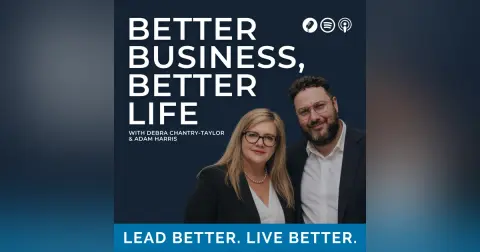
Erik Dodier: The Power of the Visionary/Integrator Relationship in EOS
In this episode of Better Business, Better Life, Debra Chantry-Taylor sits down with Erik Dodier to explore the power of the Visionary/Integrator relationship and how it can completely transform a business.

 Spotify
 YouTube
 Amazon Music
 Apple Podcasts
 RSS Feed
 iHeartRadio
 PocketCasts
 RadioPublic
 In this episode of Better Business, Better Life, Debra Chantry-Taylor sits down with Erik Dodier to explore the power of the Visionary/Integrator relationship and how it can completely transform a business.
Erik shares his journey from growing Pixel Media from zero to $15 million without EOS to an impressive $75 million after implementing it. The turning point? Fully embracing EOS, particularly the visionary-integrator dynamic, which brought clarity to roles, improved decision-making, and reduced the chaos that often comes with rapid growth.
He dives into how separating visionary and integrator responsibilities allowed both leaders to play to their strengths, creating a more aligned and accountable leadership team. Erik also highlights the impact of key EOS tools such as the accountability chart, quarterly rocks, and Level 10 meetings, along with the use of platforms like Ninety.io to keep the business focused and connected.
The conversation also covers how EOS helped the company navigate the uncertainty of COVID-19, maintain strong communication, and continue scaling through strategic acquisitions. Erik reflects on lessons learned, including the importance of fully committing to EOS rather than partially implementing it.
Now an EOS implementer himself, Erik works with businesses of 10 to 500 employees, helping them achieve the same clarity, structure, and growth he experienced.
If you're looking to scale your business without losing control, this episode offers practical insights into building a strong leadership partnership and leveraging EOS for long-term success.
CONNECT WITH DEBRA:
___________________________________________
►Debra Chantry-Taylor is a Certified EOS Implementer | Entrepreneurial Leadership & Business Coach | Business Owner
►Connect with Debra: debra@businessaction.com.au
►See how she can help you: https://businessaction.co.nz/
►Claim Your Free E-Book: https://www.businessaction.co.nz/free-e-book/
___________________________________________
GUEST’S DETAILS:
► Erik Dodier – LinkedIn: https://www.linkedin.com/in/erikdodier/
► Website – EOS Worldwide: https://eosworldwide.com
Episode 265 Chapters:
00:00 – Introduction
00:36 – Introduction to Visionary Integrator and EOS
05:30 – Erik’s Journey with EOS
05:44 – Challenges and Benefits of the Visionary Integrator Concept
09:06 – Implementation of EOS Tools and Software
09:31 – Impact of EOS on Business Growth and Structure
09:41 – Erik’s Transition to EOS Implementer
09:58 – Challenges and Mistakes in Implementing EOS
26:44 – Impact of EOS on Business Communication and Accountability
36:31 – Erik’s Experience with Clients and EOS Implementation
41:17 – Final Thoughts and Advice for Business Owners
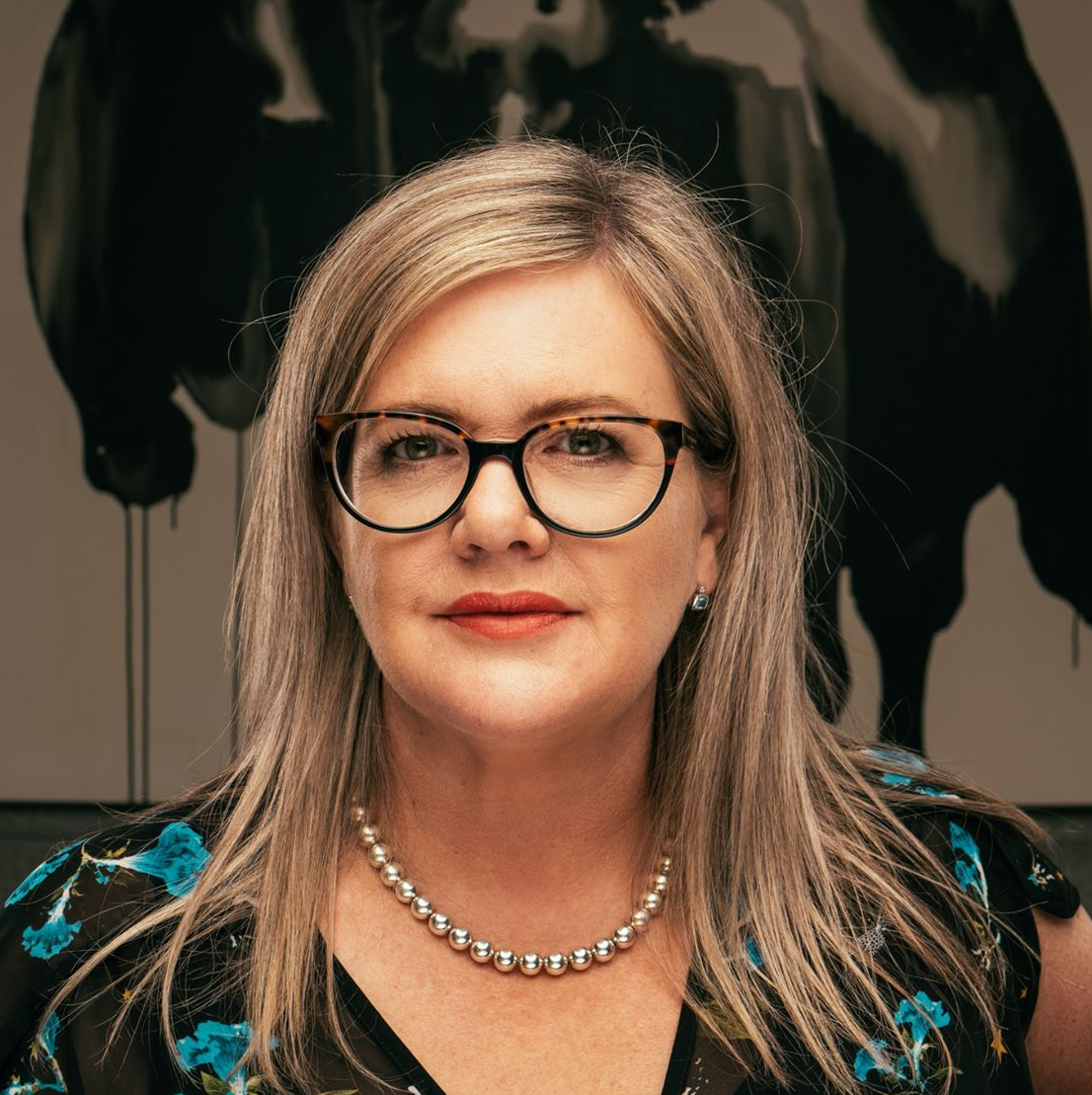
She is based in New Zealand but works with companies around the world.
Her passion is helping Entrepreneurs live their ideal lives & she works with entrepreneurial business owners & their leadership teams to implement EOS (The Entrepreneurial Operating System), helping them strengthen their businesses so that they can live the EOS Life:
- Doing what you love
- With people you love
- Making a huge difference in the world
- Bing compensated appropriately
- With time for other passions
She works with businesses that have 20-250 staff that are privately owned, are looking for growth & may feel that they have hit the ceiling.
Her speciality is uncovering issues & dealing with the elephants in the room in family businesses & professional services (Lawyers, Advertising Agencies, Wealth Managers, Architects, Accountants, Consultants, engineers, Logistics, IT, MSPs etc) - any business that has multiple shareholders & interests & therefore a potentially higher level of complexity.
Let’s work together to solve root problems, lead more effectively & gain Traction® in your business through a simple, proven operating system.
Find out more here - https://www.eosworldwide.com/debra-chantry-taylor
SUMMARY KEYWORDS
EOS, visionary integrator, business growth, accountability chart, state of the company, traction, private equity, business structure, leadership roles, employee engagement, business tools, exponential growth, business strategy, business communication, business success.
SPEAKERS
Erik Dodier, Debra Chantry-Taylor
Erik Dodier 00:00
So the idea of visionary integrator just letting that visionary play to their strengths, and then let the integrator manage the day to day business in those very early days. Yeah, maybe you have to. But as you grow, if you really want to break through, I think splitting those roles up, that's why they call it rocket fuel. EOS actually saved our business. Have we had to go through covid Without EOS? Like everybody was, would have been panicked. 10x is better than 2x because when it's 2x you just try to work harder, you just try to go faster and do more work. If it's 10x you almost have to change how you think. Hello
Debra Chantry-Taylor 00:36
and welcome to another episode of Better Business, Better Life. I'm your host, Debra Chantry-Taylor, and I'm passionate about helping business owners lead better lives by creating better businesses. I started this show to actually bring people into the listeners homes who have actually been there, done that, got the t shirt, gone through the highs and lows, used EOS in their business, and many have gone on to become EOS implementers, as is the case today. So today's guest has actually grown a business from zero to 15 million over 20 years without EOS. They then brought EOS into the business and took it from 15 million to 75 million, and they had over 500 employees by the time they actually sold that business. And today they're going to share with you how they rolled out EOS in the business, some of the challenges they came up against and how they managed to navigate it was such a large business, how it changed their thinking, and therefore how they got to that 75 million and what it's now like to be helping other businesses with EOS as an EOS implementer. Erik dodier is the former CEO of pixel media. He was the integrator CEO in that business they were running on Eos, and now he is an EOS implementer. Welcome to the show. Erik, great to have you here this morning.
01:49
Yeah, thanks. Debra, great to finally connect with you. Yeah.
Debra Chantry-Taylor 01:52
I'm looking forward to sharing your stories with our listeners, because we've had a little bit of a chat before. As always, we're working on the podcast. So you you got into EOS because you had been running EOS in your business. Why don't you tell us a little bit about that story and how you got to be where you are now, I'm
Erik Dodier 02:07
lucky I have both experiences. I've been a client using Eos, and now I've become an us implementer. So I see it from both sides, and it's but how I got into EOS? I started a business when I was 24 so about 30 cup, 30 something years ago, and we ran that business for about 20 years. You know, struggled. Had a partner. It was chaos. It was just making up as we went along. It was sort of a web design development company. We pivoted into becoming a Salesforce partner. And along the way, somebody had posted on LinkedIn that they were doing EOS implementations, and somebody I knew and trusted, I gave him a call, a gentleman named Rick faucet. He came up, spoke to us, and I said, I'm in. Let's, let's try this. And it was funny, from the from from year one to year 20, or almost 25 we grew to about zero to 15 million in revenue. One five, the next three or four years running, on Eos, we grew to 75 million in revenue through some private equity Mergers Acquisitions. But I'm just amazed when you can get that vision crystal clear, like EOS helped you do. I mean, we are very clear what we wanted to do, and it just helped the business really take off. So we ended up selling that business in 2022 I stepped away in 2024 and about six months, just to kind of figure out what it out what I wanted to do next. And I always knew EOS would be something I'd want to look at again from the implementation side. So I actually reached out to Rick again. He put me in touch with the US folks at worldwide, US worldwide, and I went to boot camp about a year ago, and I've been working with clients now on the other side, helping them implement the US. It's been such a amazing opportunity to do this now in sort of a, sort of a half retiring, but half I like, I love entrepreneurs. I love small business, so I want to just stay involved. Perfect.
Debra Chantry-Taylor 03:52
I love that story. And that's, that's huge. I mean, to go from zero to 15,000,001st of all, it's quite impressive. So congratulations on that. But then to take it from 15 to 75 is, huge. And you alluded to the fact that you changed the way you thought about the business, and you got very clear on the vision. Can you give us a little bit of insight into that?
Erik Dodier 04:10
I drank all the orange EOS Kool Aid, right? I mean, when they started rolling this out, I thought this just makes so much sense to me. You know, I'm a keep it simple person, all the tools, all the methodologies around Eos, and we just started rolling it out. And I was, I became the integrator, because actually my business partner was more the actual he loved being out in the marketplace and talking about the technology. And he really kind of had those visionary qualities, kind of external facing, working with our biggest clients. And I had which we didn't even realise until we did the exercise with the visionary integrator, that I was more the integrator. I liked keeping the trains running on time. I liked managing the business. I loved managing the metrics and just that clarity alone as two business partners that were literally 5050 owners and the employees were already always confused. Well. Should I go to Erik? Should I go to Tom? Even that alone helped with the decision making and helped us move quicker. So everything that EOS brought but that vision specifically, you know, getting our core values right, a 10 year target, and then working it backwards, you know, like starting where you want to be in 10 years, and then if we want to be here in 10, let's be here at three. We're going to be there in three years. Let's be here at a year. And then now let's just break it down into quarterly chunks. And that just made so much sense to me. And then off we went. And it's funny, the employees of all the things decisions I made, I think EOS was the one that they overwhelmingly loved. I mean, every other decision always had about, you know, half people liked it, half people didn't that one. Everybody seemed like, yeah, this was a good decision to put this EOS programme in. Yeah, I think
Debra Chantry-Taylor 05:51
it's, I mean, I don't know for your your experience, but from my experience, it's often the visionary that doesn't want to put it in, because it does bring a little bit of structure to them. And they, they quite enjoy the chaotic lifestyle in some respects, but then once they put it in, they say, completely different. That's a great
Erik Dodier 06:05
point, yeah, because he is a little more, you know, he wants to improvise a lot more, right? And, and that's a strength. That was a strength he had, but EOS allowed me to justify why we needed more structure and more, you know, kind of rigour, and let's get things in writing. And so it kind of justified, hey, this is, this feels good to me. And and he was, he was all for it, because he knew, hey, we were on the same page where he wanted to take the business, but we just had different ideas of how to get there.
Debra Chantry-Taylor 06:32
So it is interesting, because I know I've had this a couple of times now, with more than a couple of times, a number of times, I should say, with clients where they've read the rocket fuel book, and it has been a light bulb moment. And so for people listening in, they may not know what a visionary and an integrator really is, but the rocket fuel book explains that that was written by Gino Wickman and Mark winters, he's now written his visionary book, which I don't if you've read, but that is the next level for visionaries. But tell us a little bit about the visionary, integrated concept, because it is not necessarily common language in business. How would you describe it? What does it? What did it
Erik Dodier 07:03
do for you? Well, for us. So we had this natural partnership that formed when we were both in our mid 20s, right? And he was the technology guy and I was the business guy, right? And we also had different personalities and different styles, but we didn't have a vocabulary to describe it. We just sort of, you know, played to our strengths. And, you know, employees would sometimes come to me. It was kind of like mom or dad. They would go to whoever they thought they can get the best answer from, you know, and if they didn't like the answer I gave them, they'd go to see him. But as we went through the OS process, it became really clear when they said, Hey, these are the qualities of a visionary. You know, they get lots of ideas. They love the external working with the big clients, the big relationships, and the integrator likes to, you know, as I said, keep the trains running on time, manage the business. You think more with logic versus emotion. And it's funny, we when he, when he, when our integrator, looked in the room and said, Okay, guys, Erik and Tom, who's the integrator, who's the visionary, they were like, it was so obvious, and so that clarification just helped us get in the right seats, and then we started kind of building the business from there. But yeah, the visionary integrated. I just bought the book that Mark winners wrote, The visionary integrated, and there's so many great resources. But yeah, the concept is, you know, a lot of founders are visionaries, and they'll try to build their business, you know, hustling and but they can create a lot of chaos as they push a lot of ideas down onto the team quickly. And they often need an take their ideas and sort of help, you know, filter those ideas down to the team, because sometimes the team is just bouncing back and forth from every idea week to week. So the idea of visionary integrator, just letting that visionary play to their strengths, have lots of ideas, get out in the marketplace and then let the integrator manage the day to day business. And I
Debra Chantry-Taylor 08:50
think even though there are probably some people who think that they can do both, and there are some people who genuinely can, but you can't do both in the same organisation, can you? You can't
Erik Dodier 08:59
do both, you know, probably in those very early days, yeah, maybe you have to, but as you grow, if you really want to break through, I think splitting those roles up is, that's why they call it rocket fuel. It's like rocket fuel for the business. And you know, even though we were the same people, once we got into those seats, our business, our business, truly took off from that point forward.
Debra Chantry-Taylor 09:18
So pretty amazing. And it probably ties in with one of my favourite tools, which I think is the tool that most people who try to self implement EOS don't do particularly well, and that is the accountability chart. Because, yes, defining that visual and integrated role is one part of the puzzle, but defining everybody's roles, most people read the traction book, and they go, Oh, great, we'll build a two page plan. And then they rush off and they do it on their own. And then they just tell the team, this is what we're going to be doing. And then they wonder, why nothing? Really changes.
Erik Dodier 09:44
Well, and yeah, and everybody thinks the accountability chart is just another name for the org chart, and it's it's really not right. It's really about defining so clearly what that seat needs to do. And then everybody agreeing that the person leading that seat or in. That seat is the right person in the right seat that now you have to give them, you know, give them accountability to execute on that seat. And that's, that's really the difference, I think, is you're, you're creating an environment where, if you're in a seat, you're responsible for those, you know, those five key roles. And now, as a leader, your job is to just make sure you have all the right people in the right seats. And I never felt like I was the best at anything in the business. I was just the best at trying to orchestrate getting all the right people and and this even was again, another breakthrough to say, Wow. You know, maybe at times we've let people stay in seats that we shouldn't have, right? Maybe it didn't fit the culture, you know, as the company grew. Or maybe they didn't. Maybe the role outgrew, you know, their ability, and we let them stay in that seat a little too long. But when you can get all those right people in the right seats, that's a that. That's that's, again, another big catapult for the business. For sure.
Debra Chantry-Taylor 10:59
What do you think was the the the key thing that really started that flywheel turning. I mean, you talked about the vision earlier, so getting very clear on the vision, but it, you know, it's a big change to go from the size that you were to the size that you got to what was the biggest kind of catalyst in which was the EOS tool that really helped. Well, as I think
Erik Dodier 11:18
about it, I always think about how EOS sort of promises or you can reduce the chaos. And I think EOS creates everything in your business, right? Your Goals go here. Your quarterly rocks, go here, your issues go here. I found that when I go have coffee with people now and I start talking about Eos, so they start telling me what's going on. What's going on in their business. It's like The Matrix, I can see so clearly, like exactly where the issues are. Just as they're talking they're going, Oh yeah, we've got an owner, and he's got all these ideas and and then he just hired somebody, and they don't fit, and they've been around for Yeah, and I could just see everything falling right into place with all the different tools, but I think it was that everything has its place, like kind of within the EOS framework. And I think that's what the employees felt, is the business felt less chaotic, right? We weren't changing our mind every day on what the priorities were. We weren't deciding, you know, oh, we got a strategy, but oh, we get the opportunity. Let's just do this other thing, you know, core focus, staying on our core focus. It was so many things that we started the US in 2019 and then covid hit. I think about the time when you started your practice, and we start using a tool online to collect everything. Because everybody was now going virtual. And people had said after a couple years after covid, that they think that EOS actually saved our business. Have we had to go through covid Without EOS? Like everybody was, would have been panicked, because we all were started to work from home. A lot of people kind of gave EOS credit for keeping the business together and focused. Yeah, that's great.
Debra Chantry-Taylor 13:01
Yeah, the software can certainly help a lot. What software did you use that of interest?
Erik Dodier 13:05
We use 90. Yeah, ninety.io was, in fact, I use that pretty much with all my clients. That's the one they choose. I'm familiar with it as well. Yeah, yeah,
Debra Chantry-Taylor 13:19
no, there is some great software out there. I work with 19 and a couple others as well, but it's really, it is amazing how people resist it at first, I think particularly this side of the world, because it's building US dollars, and people going, Oh, it's got a bit of money to have it, but the amount of time that it saves you, and then also, I think, the visibility across the entire organisation. So for the visionary that's perhaps struggling to let go. They can kind of dive into it. They can see everything, if they want to, without having to actually middle in the day to day running of the business.
Erik Dodier 13:49
Yeah, I think the employees love it too, because, you know, they're always want to know, hey, what's the vision of the business? Where are we going? What's the plan? And even though, you know, I thought prior to us, I thought I was sharing all that. In reality, I really wasn't, not as much as I should have. But with the with the software, it's always there. So your long standing employees, you know, they've heard it several times when you do the state of the company and other Eos, you know, quarterly meetings, sharing. You know where you've been, where you are, where you're going, so just sort of sharing that on a quarterly cadence. But anytime an employee says, Hey, what are our rocks for the year? What are we trying to accomplish? Or our rocks for the quarter, what are our goals for the year? You know, I can say, hey, look, it's all up there. You know, look at it. If you have any questions, let me know. Or there, our managers can share that down with their team. So, you know, we are up to about 500 people at the at the peak, when, when we sold the business, we put everybody into the software, which, you know, was a bit of an expense, but when you have a very spread out team, that was kind of the glue that kept everybody together, like we all kind of had that shared experience, and we could all go in the software, look at the VTO, the vision. The 10 year target, core focus, you look at the rocks for the quarter, every team could run its own l 10 with the issues, right, the weekly meeting. So, like I said, every everything in the US had its compartment. And I just love that, you know, I love that it has all stitched together.
Debra Chantry-Taylor 15:15
Were there any mistakes that you made on the journey, things that you kind of, you know, wish that maybe done differently. I mean, not that we want to dwell on the past or try and change things, but is there anything you kind of went I wish we'd done that sooner. Or, Yeah, I wish we'd let that person go soon. Or whatever it might be, what were the What do you mean the biggest challenges you had along the way?
Erik Dodier 15:33
I think, as things would come up in the business, I tried to remind myself that a lot of times the answer was, you hear it now all the time. As an implementer, the answer is, in the tools, you know, just there's always a tool to solve. You know, you got an issue which, which tool could best solve that, or which of the six key areas, or is it? Is it a vision issue, a people issue, a data issue, you know, a process issue. But I didn't always think that way. I would do my EOS work, do the L 10 meeting, and then something would come up in the business, and I would just sort of try to solve it, instead of pausing and go, all right, if I think through the EOS lens, you know, how does it fit? And you know, we'd have our quarterly meeting, and our implementer would come back. So, okay, well, let's see how these issues fit in. But it just took time, you know, to finally realise that EOS is a very complete system, and there were some things around the people, right? You know, you you always sort of are trying to fit people in, because it was, it was hard to find people and technology and so forth. So we were, at the time, I'm not sure we were always as diligent about right people, right seats. We might have given some latitude there at times. But other than, you know, other than that, and being an implementer, now, I see so many things that we were only just skimming the surface, you know, as a client, because there's a lot there us. There's so many layers to it. You know, as you go, as you learn, learn more and more. I think now, if I was running EOS. Now, I'm like, it would have been amazingly. I mean, just everything can kind of fall into place with ELS, but I think it was just often not letting the tools solve some of the problems that we had. We sort of were sort of half using EOS at times.
Debra Chantry-Taylor 17:15
Again, I want to go back to the way that the thinking changed, because I'm an avid reader, and I've just finished reading the science of scaling, and now reading time as a tool. I love, I love reading these things because I don't, I mean not that it changes the way that I implement Eos, because, as you said, EOS is a complete set of tools, but it does change your mindset, and it just does, just give you that little helpful things you can share with clients. And one of the things I learned from the science of scaling was that, you know, we often don't set truly impossible goals. We have our self limiting beliefs that kind of jump in. And then in our 10 year target, I've got some clients who have definitely got big, hairy, audacious goals. Others, I think, are a little bit more reserved, and they're always like but we don't know how we're going to get then I say, it doesn't matter. You don't need to know, Al easy, to know what you really want, and you'll, you'll find a way to get there. So what? What changed for you with by exploring that
Erik Dodier 18:04
10 year target? Yeah, I think when with our implementer, with Rick, he was really encouraging us to making that same statement, like guys, you know that 10 years out is meant to be aspirational. You're not going to know exactly how you're going to get there. You know, that's part of what's gonna, you know, pull you forward. So I can remember when we set, you know, you always set a revenue goal, and it always seems like, my god, it's taken us 25 years to go from zero to 15 million. And why do we think we can be, you know, 50 or or 100 in five years or 10 years? And but yet you said it, and then you start working backwards. And it's funny, your brain starts to think a little differently. It's kind of like, I think you see a lot, you know that that going something 10x is better than 2x because when it's 2x you just try to work harder, you just try to go faster and do more work. If it's 10x you almost have to change how you think, right? And I think that was what we realised, is, you know what? We can't get there hiring one person at a time the way we've built our business today. But we could get there if we bought a business that comp, that complemented us, and then we could offer bigger solutions. And we bought another business that complement us. We actually merged, actually three business that were almost about the same size, and that was a that was a game changer. We hadn't really thought that was the best way to do it, or hadn't entered kind of our thought process. But when you start working with private equity and thinking, hey, they know how to put these pieces together. And sure you're going to own a smaller piece, but of a much bigger pie, you know, as you start to do this, but you got to get, you got to let that go in your head, like I don't have to own 50% of this business. In fact, this path we're on is to build something bigger, more impact, bigger scale. I think that. The biggest shift is the vision. Whether we knew it or not, we were thinking differently. Maybe we might not even have realised it right in the moment. We just thought it was the next best step to take. But I think it really shifted our thinking of how to grow the business.
Debra Chantry-Taylor 20:13
Yeah, I tend to agree. And I think it's, you know, they put 10x is easier than two x's. I always sort of said that, you know, if you just so that you're thinking about organic growth, if you can spreadsheet, it probably not going to happen, but you need to think quite differently. And I talk about polishing the turd. And I don't mean that your business is a piece of shit at the time, but if you're just always polishing it to make it a little bit shiny and nicer turd, it's still a turd. It's like, what can we do differently? Kill, kill the stuff that is maybe not getting us there. And what can we do differently to actually really achieve. Because I think a lot of the visionaries that I work with, they have got huge you know, they want to make a huge difference, and they've got these huge goals, but they're always a little bit afraid to share it with the rest of the team, because the rest of the team tends to be more about Yeah, well, how are we going to do it? But if you can actually get that out and share it with the team, and they truly understand where it came from, what the passion is to achieve it, then they actually get behind it. They get very excited by it. Did you find that in your team?
Erik Dodier 21:04
Absolutely, in fact, that that's another great, great point is, you know, Eos, we talk it's really a system to harness human energy, you know, and and in a services like what we had, the more everybody is going in the same direction. You know, you're not, you're not wasting energy on things that aren't kind of in the direction you want to go. So when you get everybody going in the same direction, the momentum you start to create just goes so much better. There's a book out there, and if you ever heard of the book called u squared, it's, it's really, it's the thought about sort of exponential growth. Everybody tries to go kind of linear, you know, step by step by step. And it's a really short book. You can read it literally in like 30 minutes. It's in it talked exactly about that is not trying to think of everything doesn't have to be linear, exponential jumps and, yeah, really interesting concept. But same idea with going for versus 2x it actually it forces you to think a little differently about what you're trying to do.
Debra Chantry-Taylor 22:03
Okay, great. So you've you've switched sides now. You're now on the side of helping businesses, as opposed to running in your own business. How has that been for you, and what have you really enjoyed about it?
Erik Dodier 22:14
Yeah, so about a year last year ago, I thought, Okay, I've got a lot of time on my hands now, after I stepped away, which was intentional, but I was ready to kind of fill some space with working with the entrepreneurs and small businesses, which is what I've always loved, even throughout my my career of owning that business, I loved anything that was a startup, nonprofits I worked with or starting us, you know, joined a board of a new bank. I mean, everything I did always had a sort of a startup feel to it. And I thought EOS just creates a great platform to do that. So I just reached out and signed right up for boot camp, went out to Detroit, got the training, and then put it out really on my my LinkedIn network, and already started picking up some clients. I've been adding about a client a month, you know, in those first eight or nine months. And I love the learning. I love going on the, you know, the academy, and watching the videos ahead of my sessions. And I'm a big repetitive, like, I'll listen to it two or three, you know, three, four or five times if I have to, to sort of really get the flow of what I'm what I'm teaching, and then sort of tie back to the stories that I lived, you know, running my business, pixel media within rafter one for 30 years. And you know, I think the clients really appreciate that, because they know not only did I am I teaching Eos, but I used EOS in my business, and we had incredible success with it. So I can speak firsthand about how well it works. And they're just mean, you know, I love, like, focus days. I love, I love, I love those first three days, because they're just their eyes are wide open. Like, every session they come in, like, oh my god, this is incredible. Like, and now I'm into some quarterly sessions, and now they're starting to build momentum. But it's great being on this side of it. I'm I'm loving it.
Debra Chantry-Taylor 24:04
Yeah, it's a lot of fun. It's one of the things I actually fell in love with about EOS before I signed up, was that all of the EOS implementers are actually entrepreneurs. All of us have sort of run businesses. We've been in the trenches. We've had the successes. We've had some of the lows as well. And we're not coming from a theoretical place, but we were using, as you said, those stories to back up the framework of Eos and and I think I always say that, you know, yes, with the dumb blonde at the front with the marker pen, but with the dumb blonde who is also a curious child and asked questions. And those questions come from knowing what we see with other clients, knowing what we've been through in our own businesses. So, you know, that's what gives us the the depth, I think, as EOS implementers, as opposed to a business coach who's who's just followed some sort of template and come out and kind of gone, right? Now, I'm a coach,
Erik Dodier 24:52
yeah, and the variety of businesses, right? EOS can work. I think Gino Wickman said, you know, does it work with. Re business. And his answer was, Well, do you have humans that work there? And the answer is, yes, the US will work. So I've got, you know, an HVAC company, an optometry practice, a real estate, you know, it's all different variety, but the principles and the tools work the same. And so, yeah, I'm really enjoying it. And the clients have been great. They're very appreciative, you know, they leave a session and I'll, I'll hear just within three months, like, yeah, we already feel the energy. Things feel like they're running better. That makes me feel good. You feel really good when I when I hear that, especially from the founders, especially when I meet them early on, and they're just, they're frustrated, and they're sort of sharing their whole story. I just walk in their office and I can see the traction books sitting on their desk, and they start just venting, like, Erik, we need this. I've got friends in other industry, industry that are that are using it. When can you start? And I said, Well, hold on, let's, you know, let's do the 90 minute and but then to hear three months later that they feel like they're getting good, good progress and traction. It's just, it feels really good.
Debra Chantry-Taylor 26:09
I'm similar. I've got about 24 clients across Australia and New Zealand. So also works across countries, of course, because we've got the US influence all around the world and and again, everything from, you know, people who manufacture and have a manufacturing plant right the way through to software as a service. Through professional services, you have to product services, manufacturing, whole raft of things. And as you said, as long as I've got people, it is a people management tool. So it's people energy kind of management tool, which means it will work if you've got humans in the business. What I love is the same thing is that it's not going to change the business overnight. But if you follow the process, even within that first three months, we see significant change. And you know, when you get those phone calls from your client and they go, Oh, we've just run out a USD Level, Level 10 meeting, and it was fabulous. And if it's like suddenly that they're loving meetings again, because how many, how many clients do you have that come in and they're just specially visionaries, oh, another bloody meeting. You know, what are we going to get out of this one? So that level 10 meeting tool just changes everything, right?
Erik Dodier 27:05
Yeah, every check in we do, that's probably one of the most common things I hear, is they love the they love the level 10 meeting. It just, you know, they love that they're solving issues, they're getting things out on the table. They're holding it regularly, you know? And I think the management teams appreciate it too, because they they probably wanted that more communication with the, you know, with the integrator and with the visionary, but they were just never able to get it consistently, and EOS creates that environment. And so they're almost thrilled that EOS has arrived on the scene like, Finally our owner, our owners, are paying attention to us and solving you need to solve. So it's both good for the owners and the founders, and it's good for the leadership team that's been dying to have that more regular communication.
Debra Chantry-Taylor 27:50
Absolutely. So what are the tools you talked about, which, again, I think is a tool that's not often talked about, but the state of the company update. So this was something that is, years introduced by EOS teams as they roll it out to the organisation. And it's about sharing, you know, what we've done the last quarter, where we're headed wings, all those sort of things. What? What were you doing anything before that in terms of communication in the company? And how did that change the way you communicated?
Erik Dodier 28:16
Yeah, I think we were doing things in our business, you know, before we started doing the formal state of the company meeting, we were doing things, but it was very sporadic, you know, kind of when we felt like it well, when we felt like we had some big news. So six months could go by and it feels like a blank, you know, you've barely, you know, and all of a sudden you're like, wait, we haven't even had a company meeting in six months. And because, you know, I was, you know, even though I was the CEO, we were still a relatively small business. So, you know, I'm a doer. I like to do stuff. I like to get stuff done. And people like, Well, Erik, we go to meet. I'm thinking, Oh, they know all that. They hear all that we talk about it, you know, they hear it in the kitchen. I think the state of the company is a way of just formalising we're going to do this every quarter. But as we got bigger, we actually went to a monthly because there's just so many things happening. But it kind of followed the same format, but the state of the company typically is a quarterly. You know, where you've been, where you are, where you're going, you're sharing the rocks that you're working on like. So what are the priorities? I think the team wants to hear what are the priorities for the business, because they want to, they want to help, and if you don't tell them, they can't help, and then we're always frustrated that, oh, why aren't the employees helping us solve the big problems? Well, you didn't tell them what they were. So the quarterly rocks really is a format that you're sharing what the rocks are, and then you're also sharing how did we do the previous quarter? Which kind of is making you and the leadership team as the owners, accountable, right? You say, Hey, this is, these are the most important things we're gonna get done, and we're gonna tell you how we did in three months. And so you don't want to stand up there in three months say, Oh, we didn't get any of that stuff done, right? You want to be able to so it even drives your own accountability. And so. So that's kind of, I feel like it creates accountability up and down, right? It makes the leaders be more accountable to what they say they're going to get done, and it allows the teams to participate in those most important things in the business. So yeah, in fact, I was just sending, I sent an email earlier today. I had a quarterly session a couple days ago, and it was their first quarterly, and then they're going to do their state of the company, and, you know, share the Eos, you know, really what they're doing, and start to formally, start to roll out EOS. And of course, there's always a new book coming out about EOS. That's what I love. Every book support all the other parts. And the book rollout is out, and the visionary book. So, I mean, there's always some good, more resources to to go deeper.
Debra Chantry-Taylor 30:42
And what I've discovered is, you know, when, when people, it's funny. I have some clients who actually resist doing the state of the company thing, because they sort of say, Oh, well, you know, we run a we run a retail business with all these people working the store. They don't want to know what's going on. But I think that that they, when they do do it, they realise it's not true at all. Even a person who's working in the produce department putting cabbages on a shelf, wants to understand how they fit into the bigger picture, and the state of the company does that. It talks about where we're headed as an organisation, and it gives them a little bit of a sense of what is possible for them as well. So you know, if they want to progress with the company, they can see the growth, they can see what's happening. But also, if they just want to stay putting cabbages on shelves. That's absolutely fine, too, but they understand that that is actually contributing to the bigger picture. They understand what the 10 year target is, understand what we're trying to achieve as a group. And it's very rare that people don't want to understand what's going on. And if they really don't want to understand, they're probably a bit of a people issue, right? Yeah.
Erik Dodier 31:38
I mean, you know, worst case, they spent an hour listening, and, you know, they'll, maybe they'll find their way to go do something else that they'll be more, you know, inspired about, but yeah, and again, and repeating things often, right? You know, telling people things many times. We would just go through our entire VTO almost every time, because sometimes you had new people, they haven't heard it. We, we'd have different leaders share different leaders share different parts of it, talk about the core values. So there's always something new there that people hear. You know, we think as the leaders, because we're talking about this stuff all the time, but they're not so we, you know, this is their chance to hear, really, what's that vision all about? So, yeah, it was, it was, we made it an event, you know, like every quarter. This was something we were going to
Debra Chantry-Taylor 32:22
do, and it's a chance for the team to celebrate success, as well as my look at, you know what's going on. Yeah, it is. It is amazing when you actually see that. I've been very privileged to sit through a couple of the standards of the company, updates with clients I've been working with, and just to see it. But also I think about from my perspective, and I think about it from our own businesses. We run EOS in two out of our three businesses, and and then also from an EOS implemented perspective, even though, yes, I mean, I've been an EOS implementer for six and a half years, which means I've actually attended 25 like that, coming up to my 26th kind of quarterly. So I've actually heard Mark O'Donnell and Kelly and before that, others, every single time go through the core values, go through the whole VTO and share all that stuff with me. And every time, I still take something new from it, and even things that I've heard, you know, all those times, it's still like, oh, yeah, that's right, that's that's what we're trying to do here. So I think we can't underestimate and I know that when the Eos, they say that it takes seven times we call you here for the first time. There was actually some research on about 18 months ago that actually proved it's about proved it's about 32 times now, because of all the technology and everything that's going on, we've we're hugely distracted, so you know, and I used to say to clients in the beginning, it's like, if you've told somebody once or twice, you've got another five or six times to go. Now you think about you told them once or twice, you've got another 30 times to go before they're really going to get it. So even, even if they have been there for as long as I have six and a half years, there's still going to be things that every time you kind of go, oh, yeah, that's right, that's what I'm
Erik Dodier 33:49
it's like, it's like reading a book, you know, a book that you've read before, it feels different when you read it a few years later, because you're at a different place and you're hearing different things. So I think employees, your staff the same way, you know that might be a different place in their career, and they're listening differently. You know, to hear these things so repeating it often, is a is a good, is a good, good tradition for the business.
Debra Chantry-Taylor 34:12
I'm curious, with 500 staff, that's quite a lot of people in, I'm guessing, very many different roles, and spread out all over the place. In terms of the rollout. Book talks about how you need to take it and how you have you've got your overarching kind of company, VTO, and then each department has got their own sort of traction pages, and they know how they fit into the bigger picture. How did you do that with 500 people?
Erik Dodier 34:35
We did use the software so that again, they were at least plugged into the VTO. What was going on? Their teams would run l 10s. It gets a little harder, because, you know, they might, they're not. They don't have total latitude to just create any, any old rocks, right? They got to be kind of, maybe, you know, tied into the mission of the business, maybe tied to some of the bigger company, rocks. But they. Have things in their department that they need to get done and improve quality and things like that. So there is things within their department, rock wise and things like that. So, but what I loved is, you know, issue resolution, you know, I remember, you know, when you're the CEO, I used to have this open door policy, and I thought I was being this great CEO, because I would let anybody come talk to me anytime. And what I really was creating was some of that chaos that I was talking about, because people would walk in and they'd want to, you know, give me their issues, or have me solve their issues just instantaneously. And what we learned with EOS is eventually I would just say, you know, if they reported to me, I'd say, well, just put it on the issues list, and we'll talk about it in the weekly level 10, assuming it wasn't an emergency, and that would keep me from trying to solve it instantly, because that usually was never a good result, or if they didn't work directly for me, and say, Well, you know, try to solve this at your department, talk to your manager, put on your issues list, and if you can't resolve it there, it'll come up. So it was almost just a very calm like, no problem. These are all just issues. That's just what a business is. A business is just a bunch of issues in our way towards trying to achieve our our vision. And it allowed everybody sort of a venting mechanism. So instead of just holding all these issues inside, they had a place for them that they could talk about them, and then if they didn't get resolved, that manager could take it up to their manager, and maybe eventually the leadership team would help, but it allowed all the communication to flow. And again, you can never solve all the issues in the business. It's, it's, but you're hoping you're solving the most important ones, and the ones that are you get the biggest return on your time towards the vision that you're trying to accomplish. So that's how we handled it, and we just just shared the practices we bought everybody the What the heck is the OS book we you know, they had access to the software. And of course, the other great thing about us is all sorts of tools and information online. So if people want to really learn what some of this was all about, they could even do some
Debra Chantry-Taylor 37:00
of their own discovery on it. Is a huge amount of support out there for EOS. It's not just around having an implement about years, as you said, you've got a book coming out every couple of months. You've got lots of lots of online videos, tours and things that actually help and and as an implementer, you know, we, I've done a few big manager meetings and really help bring people on that journey so they understand it. And it's always, it's always very well received, I think, particularly by mid managers. I think the mid managers love that structure and some accountability. It's an interesting thing, because I think that initially people think, oh, but accountability. That sounds like, you know, we're going to be really enforcing everything with everybody. It's going to be really restrictive. But most people like having accountability, don't they?
Erik Dodier 37:40
Yeah, I think when you put up the, I can't remember, I always try to think of this study. There was a study where they they put a bunch of kids in a big open field, and they all played in this little cluster, right? But then they put a fence around a big, big, big fence around the entire area, and all the kids played right to the edge of the fence because they knew where the guardrails were. And so I think when you put up the guardrails, the team actually now has more freedom, because now they know where the boundaries are. You know, they know their responsibility. So I think there's, I think that's why that you know, when you start putting some structure very clear on what you're trying to accomplish, employees can really contribute in a bigger way. You know where before, they might have just been in their little box, just saying, all right, I'll just do my job every day and hope for the best. And when you tell them, hey, this is what we're trying to accomplish, then they can really lean into it and say, Hey, here's where they can contribute more. You know, from the position they have, there's a clear, maybe, path towards promotions, because you've laid out your accountability chart and different responsibilities. So yeah, I think it, I think it created a lot for our staff when we when the EOS really got rolled
Debra Chantry-Taylor 38:49
out, I always say that it's like, why do we love sport? We love sport because we know how to play. We know what the rules are. We know how to win. We've got a scoreboard that tells us if we're winning or losing, and it just, it's it's easy. We know what all those rules are, and that's what EOS does for the business. It makes business a game, where we go to go. These are the rules. Is what we're kind of expecting from you, is how you win. This is a scorecard. It's having a celebrate success, and then, yeah, it just makes it easier for sure purpose. Hey, we probably talk all morning, all afternoon. For you around Eos, what would you say has been with your own clients, what do you think has been the, the most impactful EOS tool when you work with clients? Do you have a favourite? The Accountability
Erik Dodier 39:31
chart is, what, what? And again, it's, you know, that's almost the first thing we started to talk about, you know, in the early, very first focus day. And it's not so much that we're just building the what it looks like the structure, but what we're trying to describe is that you're now, if you sit in a seat, or you lead a major function of the company, we're now agreeing that you own. You're now accountable for the success of this seat and this function. And and everybody's agreeing that, yes, you own it, which I think empowers people to then want to take more ownership, more responsibility, take a little less from the founders, or maybe the, you know, the visionary integrator, that probably already feel overwhelmed, right? They probably feel like every problem is coming to them. Nobody's solving anything on their own. You know, that's the feeling they have, and it may be because the leadership doesn't feel like they're empowered to solve the problem. So I think the accountability chart sort of gives people permission. You own this, if you own sales, you drive sales. We still talk as a leadership team about the budgets and strategies and things like that, but when it comes to execution and doing the job, that's up to you. And I think it's the accountability chart. And when you're working through that and making everybody see that, if you if you're not delegating and you're not giving people the accountability, you could have a right person, right see issue, so and and so it either going to shine a spotlight that you have an issue or it's going to empower that person to take charge of that position and and I think that's what founders and visionaries and Debra is want. They want people that are in the seats to take ownership and kind of flex a little bit on the role and and do the job that they're being held accountable to.
Debra Chantry-Taylor 41:18
Hey, three top tips or tools from you, Erik, what would we like to share from both your experiences of being a business owner running EOS and now as an EOS implementer, if you had to tell the listeners three things, that they should do, a book, they should read a tool, they should do, whatever it might be, what'd be your three top tips or tools? I mean, clearly
Erik Dodier 41:35
we found our way to EOS. So I would say, Just begin the journey to look into it. And I post on my LinkedIn all the time. You know, have people take a look at EOS. You know, the other tool I love, just from connecting with people, that's how I stand for it, is I use LinkedIn a lot. I'm sure I've connected with you. Is, is I use that tool just purely getting out outside of the US, because I find the relationships, your network, is kind of a trajectory of how well you can navigate different challenges and problems based on people. You know. You know, the third thing, you know, I am a big believer. I'm kind of a law of attraction person, so I tend to really kind of, and that's also I kind of love EOS about setting that vision, you know, set the target. Set. Set this. Set the journey of where do you want to go on and just take those very small steps. I think sometimes people are concerned to take that first step because it looks so the journey looks so long, you just don't know how you're going to get there, so they don't start. And I think that, you know, a journey is just many, many small steps. I sometimes don't even know how I got here. You know, it was a 30 something year journey, and it was just little decisions daily, daily that stacked up, and eventually you've got this business that you sell. And then I became an implementer. So, yeah, so EOS would be something I'd look into if you own a business, I get clear on what you're trying to accomplish, and just don't be afraid to take a small step towards that goal and just see where that takes you. Goes back to that sort
Debra Chantry-Taylor 43:04
of thing. If you don't know where you're going, any road will get you there. So get clear on where you're going, and then suddenly the the road will appear, right? Yeah, well, that's fantastic. Hey, look, thank you so much for your time and for sharing all your insights. Really appreciate it. We're going to put your contact details in the in the podcast notes. Anybody can get in contact you if they want to. From a client perspective, what is your ideal client? Who do you love to
Erik Dodier 43:26
work with? Yeah, well, I'm located up in the in the northeast of up in the Boston area of the United States, and so most of my clients are up here. But you know, I tend to, right now, love those target profile EOS clients. So you know, there are 2 million to 50 million, you know, 10 employees to a few 100 employees, and then, most importantly, they're open minded, right? They, they know they they're open to thinking differently about how they run their business. Because if, if they think they haven't all figured out, and maybe they do, then maybe they don't need Eos, but if they've, if the business feels a little more chaotic than it needs to be, or they just kind of want more from their business, or they want more from their life, besides just running their business right. And that's really what your podcast is all about, is you can do that. I mean, I truly got the life that I have now, which is amazing, with my freedom of time and schedule, really because of Eos. And it was it, it that last five years running the business was the most rewarding five years we had that we ran EOS. The first 25 was like the preparation, you know, it was all the all the lumps and and that was rewarding too. But I can tell you that the time we ran Eos, it just felt better. Made me a better CEO.
Debra Chantry-Taylor 44:40
That's great to hear. There you go. Some hope for people out there who are into their 19th or 20th year. Just because you haven't got there yet doesn't mean you won't eventually get there really, yeah, hey again. Thank you so much for your time. I really appreciate it. All right.
Erik Dodier 44:52
Sounds good. Thanks, Debra, thank you. You.
EOS Implementer | Entrepreneurial Leadership Coach | Workshop Facilitator | Keynote Speaker | Author | Business Coach
Debra Chantry-Taylor is a Professional EOS Implementer & licence holder for EOS Worldwide.
As a speaker Debra brings a room to life with her unique energy and experience from a management & leadership career spanning over 25 years. As a podcast guest she brings an infectious energy and desire to share her knowledge and experience.
Someone that has both lived the high life, finding huge success with large privately owned companies, and the low life – having lost it all, not once but twice, in what she describes as some spectacular business train wrecks. And having had to put one of her businesses into receivership, she knows what it is like to constantly be awake at 2am, worrying about finances & staff.
Debra now uses these experiences, along with her formal qualifications in leadership, business administration & EOS, to help Entrepreneurial Business Owners lead their best lives. She’s been there and done that and now it’s time to help people do what they love, with people they love, while making a huge difference, being compensated appropriately & with time to pursue other passions.
Debra can truly transform an organisation, and that’s what gets leaders excited about when they’re in the same room as her. Her engaging keynotes and workshops help entrepreneurial business owners, and their leadership teams focus on solving the issues that keep them down, hold them back and tick them off.
As an EOS implementer, Debra is committed to helping leaders to get what they want and live a better life through creating a bet… Read More
EOS Implementer
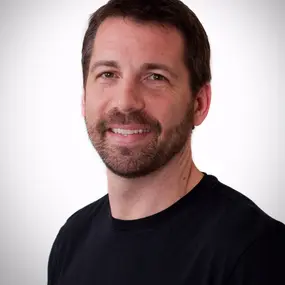
Erik Dodier is a lifelong entrepreneur, EOS Implementer, and former CEO who believes the most meaningful success comes from playing the long game. At 24, he co-founded PixelMEDIA and spent nearly three decades growing it into a leading global Salesforce commerce partner before the company was acquired by IPG in 2022. Today, Erik helps business owners design companies that serve their lives—not consume them—using the Entrepreneurial Operating System (EOS). Based in coastal New Hampshire with his wife, two teenagers, and two dogs, Erik blends real-world leadership experience with a passion for health, longevity, and building businesses—and lives—that last.